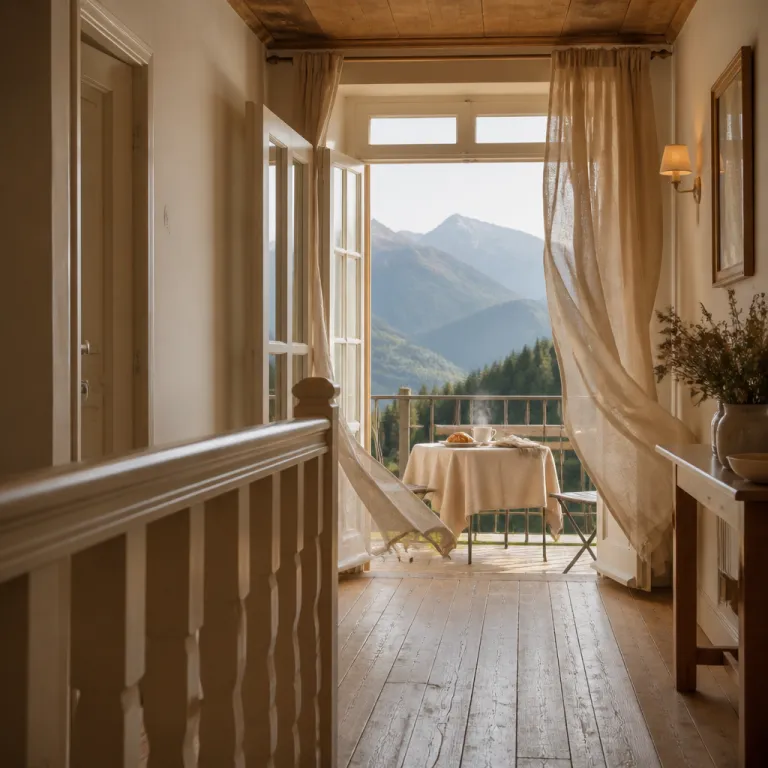
Where the Alps turn golden: hotels in the sunniest department of the French mountains
Hautes-Alpes sits at the hinge between the Alps and Provence. The glaciers are real, the cols are steep, the snowpack holds deep into spring. But the sky behaves differently here. Three hundred days of clear weather each year pour a dry, golden light across the valleys that makes granite glow amber at dusk and turns larch forests into copper tapestries by October. The air smells of resin and warm stone rather than wet fog. This is not the grey, heavy-clouded mountain experience of the northern resorts. This is altitude with luminosity, vertical with warmth.
The hotel landscape reflects the territory. Properties tend to be smaller, independently run, rooted in the villages they occupy. Service leans toward the personal rather than the polished. Breakfasts involve apricot jam made from fruit grown in the valley below, honey from hives at 1,200 metres, bread baked that morning in a kitchen you can see from the dining room. The scale is human. The pretension is low. The mountains, however, are not messing around.
Serre Chevalier and the Guisane Valley
Four villages string along the Guisane Valley floor, connected by 250 kilometres of ski terrain that climbs to 2,800 metres on north-facing slopes where the snow stays cold and grippy even as the terraces below bask in sunlight. The contrast defines the experience: ski hard on shadowed powder in the morning, eat lunch outside in a T-shirt at noon.
Le Monetier-les-Bains anchors the western end with thermal springs that have drawn visitors since Roman times. Outdoor pools steam in the winter air while snow falls on your shoulders. Hotels clustered near the baths cater to guests who ski until their legs protest, then soak until the soreness dissolves. The combination of high-altitude skiing and geothermal recovery exists in very few places in the Alps, and nowhere else in France at this level.
The restaurant culture across the four villages borrows from two traditions simultaneously. Tartiflette shares menu space with ratatouille. Beaufort appears on the same cheese board as goat curd rolled in thyme. The cooking reflects the geography: mountain substance enriched by Provencal lightness. Hotels that serve dinner draw guests who might otherwise eat out, which says something about the kitchen quality.
Briancon: the fortified city at 1,326 metres
No other ski town in France looks like this. Vauban's seventeenth-century ramparts climb the hillside in concentric rings, enclosing cobbled streets so steep they function as staircases. The old town perches above the Durance Valley with sightlines that reach across four mountain ranges on a clear morning. Staying inside the walls means small rooms, thick stone, and the sound of your own footsteps echoing off buildings older than most ski resorts by three centuries.
Below the fortifications, newer properties offer more space and direct access to the lifts. The trade-off is straightforward: atmosphere versus convenience. Both options place you within reach of the full Serre Chevalier domain, but only the old town delivers the disorienting pleasure of walking home from skiing through a UNESCO World Heritage site while the ramparts catch the last light.
The Queyras: silence at altitude
East of Briancon, past the Izoard pass, the Queyras Regional Park unfolds across a landscape that feels forgotten by the twenty-first century. Villages built entirely of stone and larch timber cling to slopes where the only sounds are cowbells, meltwater, and wind through pine. The skiing is modest in scale but surrounded by a stillness so complete it becomes the point of the visit.
Saint-Veran, at 2,042 metres, claims the title of highest inhabited village in Europe. The sundials painted on house facades track time the way they have for four hundred years. Hotels here are tiny, sometimes just a handful of rooms above a restaurant where the chef knows every guest by name. The food runs to game, polenta, local cheese aged in cellars cut into the mountainside. Staying in the Queyras strips away everything unnecessary. What remains is rock, sky, wood, and a quality of mountain silence that the bigger resorts traded away decades ago.
The Ecrins massif: glaciers and granite at the southern edge
The Barre des Ecrins rises to 4,102 metres, the southernmost four-thousand-metre peak in the entire Alpine chain. The national park surrounding it protects 91,800 hectares of glaciated terrain where chamois pick their way across scree fields, golden eagles circle thermals above the ridgelines, and marmots whistle warnings from boulder fields that have not shifted since the last ice age.
Gateway villages like Vallouise and La Chapelle-en-Valgaudemar sit at the trailheads of multi-day circuits through terrain that qualifies as genuinely wild. Hotels here understand their role: provide a proper meal, a clean bed, and a packed lunch that will sustain eight hours of walking through country where the nearest road is a valley away. The cooking tends toward hearty rather than refined, and that is exactly right. You do not want a tasting menu after descending 1,500 metres of vertical on tired knees. You want soup, bread, roasted meat, and a carafe of something local.
Vars, Risoul, and the southern approach
South of Briancon, the mountains soften slightly and the light intensifies. Vars and Risoul share the Foret Blanche domain, 185 kilometres of terrain winding through larch forest that catches the sun in ways the denser spruce stands of the north never achieve. The skiing favours intermediate ability. The villages favour families. The atmosphere is relaxed, unhurried, and entirely free of the competitive energy that pervades the trophy resorts.
Further south still, the Ubaye Valley marks the point where the Alps begin tilting toward the Mediterranean. The resort of Pra-Loup sits in this transition zone, small enough that you recognise faces by the second day, sunny enough that January terraces feel almost mild. Guests who discover it tend to return quietly, year after year, without advertising the find.
Summer: cycling, hiking, and the lake
When the snow melts, the department transforms. The Col du Galibier, Col d'Izoard, and Col de Vars draw road cyclists chasing the same gradients the Tour de France climbs each July. The switchbacks are exposed to the sun, the tarmac radiates heat, and the views from the summits extend across ranges that seem to multiply toward every horizon.
Lake Serre-Poncon fills the Durance Valley with water cold enough to shock and warm enough to swim. Sailing, paddleboarding, and lakeside dining at altitude replace the winter routines. Hotels shift their rhythm: the pool opens, the menu pivots to grilled fish and salads dressed with walnut oil, and the pace slows to match evenings that linger past nine.
- Serre Chevalier: 250 km of linked terrain across 4 villages, summit altitude 2,800 m
- Briancon: highest city in France at 1,326 m, Vauban UNESCO fortifications
- Queyras Regional Park: Saint-Veran at 2,042 m, among the highest villages in Europe
- Ecrins National Park: 91,800 hectares, Barre des Ecrins summit 4,102 m
- Foret Blanche (Vars-Risoul): 185 km of family terrain through larch forest
- Lake Serre-Poncon: one of the largest reservoirs in western Europe
- Over 300 days of sunshine annually
Which area of Hautes-Alpes suits a first visit?
Serre Chevalier offers the widest range of terrain and the deepest hotel selection. The thermal baths at Le Monetier add a dimension that few ski destinations can match. Guests who want cultural depth alongside their skiing should base in Briancon, where the Vauban old town provides evening walks through living history. For families prioritising gentle slopes and relaxed villages, Vars and Risoul deliver without complication.
What makes Hautes-Alpes different from the northern French Alps?
The sunshine changes everything. Skiing in clear, dry air under blue sky for the majority of a week feels fundamentally different from the overcast conditions common in Savoie. The Provencal influence in the food, the smaller scale of the villages, and the warmth of the welcome all contribute to an atmosphere that the mega-resorts of the north, for all their impressive infrastructure, do not reproduce. Visitors who have exhausted the northern options and want something that feels genuinely distinct will find it here.
Is Hautes-Alpes accessible without a car?
Briancon connects by rail to Grenoble, Marseille, and Gap, with shuttle services running to Serre Chevalier villages during ski season. Reaching the Queyras or the southern resorts without a car requires more planning and occasional taxi rides. The Ecrins trailheads are largely car-dependent. For a car-free trip, Briancon and Serre Chevalier work well. For anything deeper into the department, driving opens the territory properly.
When is the best season to visit?
Winter skiing runs from December through April, with the sunshine keeping conditions pleasant even in the coldest months. Summer hiking peaks between June and September, when the high passes clear of snow and the wildflower meadows above the treeline turn the mountainsides into colour. The shoulder months of May and October bring quiet valleys, closed passes, and a solitude that appeals to those who prefer their mountains empty.