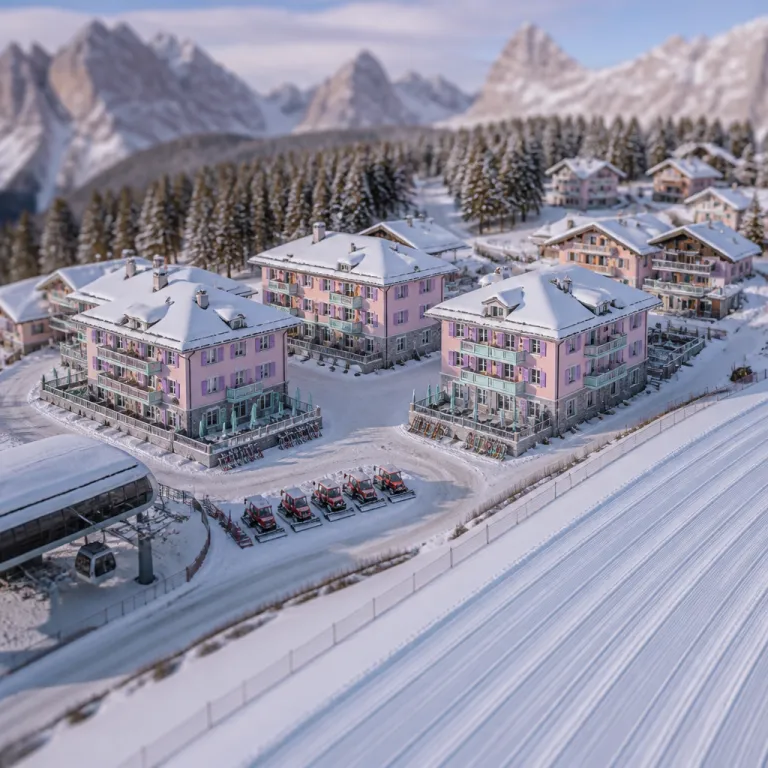
The northwest face of Civetta: a three-kilometre canvas of limestone
There is a moment in the late afternoon when the northwest face of Monte Civetta catches the sun at an angle so low that the entire wall seems to glow from within. Three kilometres wide and over a thousand metres tall, this sheer curtain of pale grey Dolomite rock shifts through copper, apricot, and a rose so deep it borders on violet before the shadow swallows it whole. No other single mountain face in the Dolomites commands attention with such theatrical conviction. The mountain stands at 3,220 metres, not the tallest in the range, but the one that mountaineers have long called the Wall of Walls, because no other summit in these Alps presents a facade of such relentless, vertical beauty.
Below that wall, three villages have grown into quiet, confident mountain communities where the hotel tradition revolves not around glamour but around proximity to rock, forest, and the cold green water of a landslide lake. Alleghe, Selva di Cadore, and Caprile form a triangle of accommodation that serves hikers, skiers, and anyone who craves the Dolomites in a register less polished and more genuine than the resorts to the west. The international crowds that fill Val Gardena and Cortina have not arrived here in the same numbers, and the result is a hotel scene where the rooms cost less, the restaurants cook with more sincerity, and the mountains feel closer.
Alleghe and the landslide lake at the foot of the wall
Alleghe sits at 966 metres on the shore of a lake that owes its existence to a medieval rockfall. The debris dammed the valley, water filled the hollow, and the result is a body of still, green water that mirrors the Civetta wall with the precision of a polished plate. In the shoulder months, when the surface is undisturbed, the reflection doubles the mountain and turns the entire scene into something almost too composed to be accidental. In winter, the lake freezes, and the ice sits beneath the wall like a stage waiting for a performance that the alpenglow delivers every evening.
Hotels in Alleghe range from traditional family-run houses where the breakfast room smells of fresh bread and the staff know every trail by heart to more established properties with wellness areas, half-board dining, and terraces that face the water. The ski lifts climb from the village toward the Civetta ridge and connect to the broader Ski Civetta domain, which itself links into the Dolomiti Superski network. The skiing here is not vast. It does not need to be. What it offers is groomed terrain through larch forest with the wall as a constant backdrop, and an evening atmosphere in the village that revolves around a handful of restaurants and a bar where locals and guests discuss the snow conditions with equal conviction.
Selva di Cadore and Caprile: the quiet approaches to big mountains
Selva di Cadore, perched at 1,415 metres on the road between the Civetta and Monte Pelmo, occupies one of the finest balcony positions in the eastern Dolomites. The village faces two of the range's most striking mountains simultaneously, and the evening terrace ritual here involves a genuine dilemma about which direction to look. This is a place for walkers who value trailhead proximity and the hush that Alleghe, popular and lakeside, does not always maintain in high season. The meadows above the village open into networks of path that connect to the high country without the crowds that gather on the more famous circuits.
Caprile, sitting at the junction where the road from Alleghe meets the routes toward the Marmolada glacier and the Falzarego Pass, functions as the crossroads of the eastern Dolomites. Cortina is thirty minutes over the pass. The Marmolada, the highest peak in the entire range, is twenty minutes to the south. Hotels here suit travellers who want to explore in every direction from a single, well-connected base. The village itself is small, stone-built, and unpretentious, with accommodation that leans toward the practical rather than the luxurious.
Walking the Alta Via 1 below the wall
The Alta Via 1, the most celebrated long-distance footpath in the Dolomites, traces a high route from Lake Braies in the north to Belluno in the south. Its passage below the Civetta wall, on the section between Rifugio Tissi and Rifugio Vazzoler, delivers the emotional and visual summit of the entire trail. The path traverses scree and grass ledges at the base of the northwest face, close enough that the scale of the rock becomes overwhelming. The wall fills the sky. Sounds bounce off it and return with a strange delay. Marmots whistle from boulders that fell from those heights centuries ago.
Hotels in Alleghe and Selva di Cadore serve as the natural start or end point for this section. The better properties arrange logistics with the efficiency of long practice: transport to trailheads, luggage transfer between refuges, packed lunches assembled before dawn. The mountain huts along the Alta Via provide overnight accommodation with blankets, simple meals, and the camaraderie that comes from sharing a dormitory with strangers who all walked the same ridge that day. For guests who want the trail without the full expedition commitment, day hikes into the Alta Via territory from the valley hotels offer a taste of the high ground without the overnight carry.
Winter terrain and summer rock on Civetta
The Ski Civetta area provides the winter framework, with lifts climbing to the ridge and connections that extend into the Dolomiti Superski network. The skiing is intermediate-friendly, through forest on the lower slopes and across open faces higher up, with enough variety to fill several days without repetition. Summer brings a different intensity. The via ferrata routes on Civetta itself attract climbers who want the exposure that the wall provides, while the gentler paths through alpine meadows and past shepherd huts suit walkers who prefer wildflowers to vertigo.
The cooking in the Civetta villages draws on Venetian mountain traditions. Polenta arrives at the table in every form: soft with game stew, grilled alongside grilled cheese, baked with mushrooms foraged from the larch forests above the villages. Casunziei, the beet-filled ravioli that the Agordino valley claims as its own, appear on every restaurant menu with a dusting of smoked ricotta. The dairy products from the summer pastures, the butter especially, carry a sweetness that industrial production cannot replicate.
Reaching the Civetta villages
Alleghe lies approximately 60 kilometres from Cortina and 130 kilometres from Venice. The road climbs through the Agordino valley past Agordo, following a river that narrows and steepens until the Civetta wall appears above the trees like a revelation. Hotels across the Civetta area provide free parking. A bus network connects the villages to Belluno and the broader Veneto transport system, though a car makes the valley connections far more fluid.
Civetta and the surrounding Dolomites in numbers
- Monte Civetta summit: 3,220 m with a northwest face 3 km wide and over 1,000 m of vertical rock
- Alleghe village: 966 m altitude, on a natural landslide lake beneath the wall
- Ski Civetta: part of the Dolomiti Superski network covering 1,200 km of total terrain on a single pass
- Alta Via 1: the most famous long-distance trail in the Dolomites, passing below the Civetta face
- Distance to Cortina: 60 km. Distance to Venice: 130 km
Is the Civetta area suitable for non-skiers in winter?
The frozen lake at Alleghe provides walking and snowshoe routes that keep non-skiers busy for days. The villages are connected by cleared footpaths that wind through forest, and the mountain huts accessible by winter trail serve hot meals to walkers. The Civetta wall itself is arguably more dramatic in winter light than summer, and the reduced visitor numbers mean the villages are quieter, the restaurants easier to book, and the relationship between guest and mountain more intimate.
Why choose Civetta over the Sella Ronda villages?
The Sella Ronda circuit offers more kilometres of linked piste and a more developed infrastructure. Civetta offers a single mountain view that surpasses anything the Sella circuit provides, accommodation at lower rates, and a hotel culture rooted in family tradition rather than resort management. The Alta Via 1 passes through the Civetta territory and does not touch the Sella Ronda. For guests who value the mountain itself over the convenience that surrounds it, Civetta delivers the Dolomites at their most honest.
What is the best season for Civetta?
Winter brings reliable snow and the ski terrain. Summer brings the Alta Via and the via ferrata routes. The shoulder months, June and late September, bring the clearest light on the wall and the fewest visitors. The alpenglow on the northwest face is most vivid in autumn, when the air is dry and the larch trees below the wall turn a gold that complements the rose of the rock. There is no wrong season for Civetta, but the quiet months reveal its character most fully.