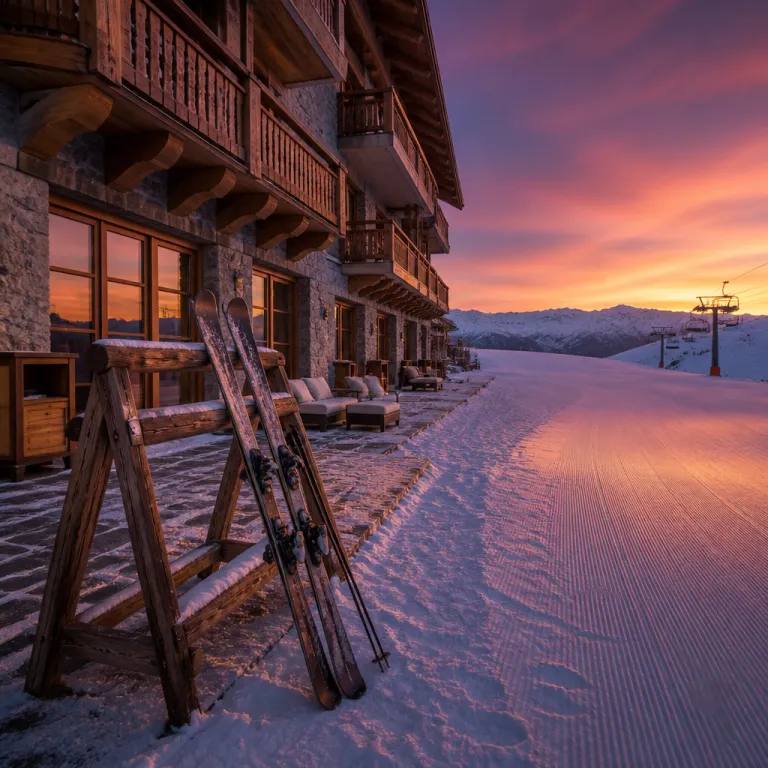
Sestriere: a ski resort born from industrial ambition at 2,035 metres
Most Alpine ski villages grew from farming hamlets. Sestriere did not. In the early twentieth century, the Agnelli family, founders of Fiat, commissioned a ski resort on a windswept pass high in the Piedmontese Alps. The result was something unprecedented: a purpose-built mountain settlement planted at 2,035 metres, anchored by two cylindrical tower hotels that still punctuate the skyline like concrete sentinels watching over the snow. That industrial origin gives Sestriere a character unlike the wood-and-stone charm of Austrian or Swiss competitors. It feels engineered, deliberate, slightly futuristic even now.
The altitude matters. At over two thousand metres, Sestriere holds snow from early December through mid-April with a reliability that lower resorts envy. Morning air bites clean and sharp. The light at this elevation carries a particular clarity, turning the surrounding peaks into something almost theatrical. For skiers who have suffered the indignity of slushy March afternoons at lower Alpine addresses, the consistency here feels like a quiet promise kept.
Sestriere also anchors the Via Lattea, one of the largest interconnected ski areas in the Alps. The domain links six resorts across Italy and into France, offering terrain that stretches from gentle nursery slopes to Olympic-grade descents. The men's and women's downhill courses from the Winter Olympics remain open to recreational skiers, and the infrastructure that international competition demanded still benefits every guest who clicks into bindings here.
The Via Lattea: skiing across a border on a single pass
Via Lattea translates as Milky Way, and the name suits the sprawling constellation of resorts it connects. From Sestriere, lifts and runs link to Sauze d'Oulx in the Val di Susa, then onward to Cesana Torinese, Sansicario, and Claviere, the last Italian village before the French border. Cross into France and you reach Montgenevre, where a ski school has operated for over a century. One lift pass covers the entire domain.
The cross-border dimension adds a texture that purely domestic resorts cannot replicate. You start the morning with an espresso in Italy, ski through a saddle between ridgelines, and find yourself ordering a vin chaud in France by lunchtime. The terrain varies as you move through the system. Sestriere delivers altitude and open, wind-sculpted runs. Sauze d'Oulx offers tree-lined descents with southern exposure and softer light filtering through the canopy. Cesana provides gentle, family-friendly terrain. Claviere and Montgenevre contribute the cross-border novelty and additional vertical.
- Sestriere summit altitude: 2,035 m, highest major resort in the western Alps
- Via Lattea connected domain: 6 resorts across Italy and France
- Sauze d'Oulx base: 1,510 m with extensive tree-lined skiing
- Cesana Torinese: 1,354 m, the quietest base on the circuit
- Cross-border skiing: Claviere to Montgenevre on a single lift pass
- Turin airport transfer: approximately 100 km, under two hours by road
- Snow season: December through mid-April at summit altitude
Sauze d'Oulx: where the mountain meets the village
If Sestriere is the functional summit, Sauze d'Oulx is the social heart of the Via Lattea. Sitting at 1,510 metres in the Val di Susa, the village built a reputation decades ago as a gathering place for skiers who wanted the mountain during the day and conversation, food, and noise after dark. That reputation has matured. The bars still operate, but the broader proposition has widened to include families, couples seeking quiet Piedmontese dinners, and groups who discover that a week here costs what three days might in a comparable French resort.
The skiing above Sauze suits intermediate skiers particularly well. Long, flowing runs thread through pine forests, and the southern exposure means the light lingers into the afternoon. On clear days, the views from the upper lifts stretch across the Piedmontese foothills toward the distant haze of the Po valley. The connection to Sestriere opens harder terrain for those who want it, but many guests at Sauze find enough variety without ever leaving the local sector.
The village itself has the warmth that purpose-built Sestriere lacks. Narrow streets, stone buildings, the smell of wood smoke and cooking garlic drifting from restaurant doorways in the early evening. Walking distance covers both the lifts and the social life, which means the car stays parked for the duration. Turin sits ninety minutes east by motorway, and the French Maurienne valley connects through the Frejus tunnel, making Sauze accessible from both sides of the Alps.
Piedmontese cooking: the mountain table
The food across the Via Lattea operates several registers above standard resort fare. Piedmont sits between Alpine pastures and the Langhe wine country, and the hotel restaurants that take sourcing seriously draw on both. Fonduta, the local fondue made with Fontina cheese, eggs, and butter, appears on virtually every dinner menu and remains satisfying on the coldest evenings. Agnolotti del plin, tiny pinched pasta parcels filled with braised meat, arrive in a napkin of butter and sage that requires no embellishment. Brasato slow-cooked in Barolo wine transforms modest cuts into something that lingers in memory longer than any individual ski run.
The wines deserve attention. Barolo and Barbaresco from the Langhe, grown an hour south in conditions that produce some of the most structured reds in Italy, appear on hotel wine lists at prices that would cause disbelief in comparable Swiss resorts. A strong Barbera with a dish of polenta and wild mushroom ragout, eaten after a full day on the mountain, constitutes one of the quiet pleasures of skiing in Piedmont.
Breakfast carries the influence of geography. The espresso is unmistakably Italian. The pastries lean toward French butter richness, a product of the border proximity. Local honey, gathered from wildflower meadows in the Val di Susa, adds a sweetness to the morning that factory alternatives cannot approach. These are small details, but they accumulate across a week into a sense that the mountain experience here involves the palate as much as the legs.
Summer on the passes: cycling and silence
When the snow melts, the Via Lattea transforms into road cycling territory of serious calibre. The Colle delle Finestre, a gravel-surfaced pass climbing to 2,178 metres through a series of relentless switchbacks, has served as a decisive stage in the Giro d'Italia and remains a pilgrimage for cyclists who want to understand what professional suffering feels like. The surface changes from tarmac to packed dirt near the summit, and the final kilometres, exposed and steep, deliver views that reward every watt of effort expended to reach them.
Accommodation rates drop forty to fifty percent below winter peaks in summer, and the mountains empty of crowds. Hiking trails cross meadows thick with wildflowers. The air smells of warm pine resin and cut grass. The silence, after the mechanical hum of winter lifts and the scrape of edges on groomed snow, comes as a revelation. The Via Lattea in summer is an open secret that the ski-resort reputation inadvertently conceals.
Which Via Lattea base suits which type of skier?
Sestriere rewards skiers who prioritize snow reliability, altitude, and direct access to Olympic-calibre terrain. The village functions efficiently but lacks the evening warmth of a traditional Alpine settlement. Sauze d'Oulx suits those who want both the skiing and the social life, with restaurants, bars, and a village atmosphere that generates its own energy after dark. Cesana Torinese appeals to families and couples seeking quiet, honest Piedmontese hospitality at the most accessible rates on the circuit. Claviere offers the novelty of cross-border skiing from an Italian base with French terrain minutes away.
How does the Via Lattea compare to the large French ski areas?
The connected terrain rivals the scale of the major French domains, with the added dimension of crossing an international border on skis. The infrastructure carries Olympic investment. The key difference lies in cost: accommodation, dining, and lift passes across the Via Lattea run significantly below equivalent French and Swiss addresses. The food, drawn from Piedmontese tradition, arguably surpasses what most French mega-resorts offer at the hotel table. The trade-off is that Sestriere lacks the architectural charm of historic Savoyard villages, though Sauze d'Oulx compensates with genuine village character.
Is the Via Lattea accessible without a car?
Turin Caselle Airport sits under two hours from the resorts by road. Trains from Turin reach Oulx station, the nearest railhead to Sauze d'Oulx, with bus connections onward to Sestriere. Once settled at any Via Lattea base, the interconnected lift system eliminates any need for a vehicle during the ski week. The resorts are compact enough that walking covers daily needs. For summer visitors, a car opens the cycling passes and hiking trailheads that public transport does not efficiently serve.
When does the snow season run at Sestriere?
The altitude guarantees natural snow cover from early December through mid-April in a typical season. January and February deliver the coldest temperatures and the deepest snowpack. March brings longer days, warmer sunshine on south-facing terraces, and snow that remains firm at the summit elevation while lower resorts begin to soften. Early April offers spring skiing conditions with reduced crowds and the first hints of the wildflower season beginning on the lower slopes.