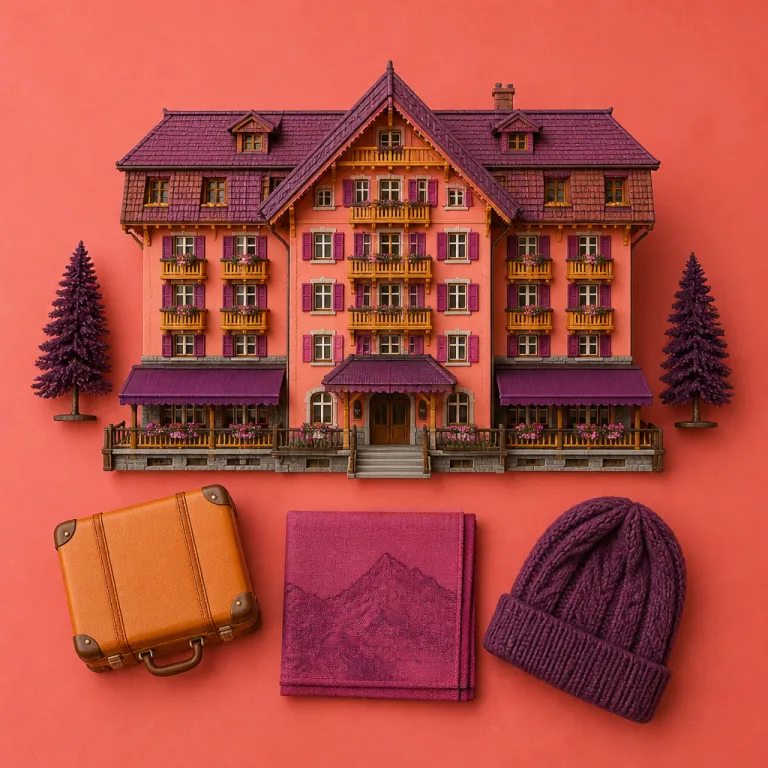
Hotels in Interlaken: the Swiss Alps gateway between two lakes
Interlaken earns its name with geographic precision. Inter lacus: between the lakes. The town sits on a narrow alluvial plain where Lake Thun drains to the west and Lake Brienz stretches turquoise to the east, while the Jungfrau massif climbs to 4,158 metres directly south in a wall of glaciated rock that turns pink at sunset. The town itself is not particularly beautiful. It functions as a junction, a transport node, a place where trains divide and passengers scatter toward the high valleys of the Bernese Oberland. That functional identity is precisely what makes it one of the strongest hotel bases in the Swiss Alps. Every signature destination of the region, from the Jungfraujoch railway to the Giessbach waterfall, from the car-free village of Murren to the lake steamer pier at Thun, falls within a day trip from an Interlaken hotel room.
The town splits across two train stations. Interlaken Ost handles the Bernese Oberland railway toward Grindelwald and Lauterbrunnen, gateways to the Jungfrau region. Interlaken West connects to Bern, Zurich, and the national rail network. A guest who understands this distinction plans better than one who does not. The flat walk between the two stations follows the Hoheweg promenade, lined with plane trees and framed by the Jungfrau at its southern terminus, and that short walk contains more postcard compositions per metre than almost any boulevard in Switzerland.
The Hoheweg promenade and its grand tradition
The Hoheweg defines Interlaken. A wide, tree-lined promenade running between the two stations, it provides the stage on which the grand hotel tradition performs. The palace-era properties along this boulevard date to the nineteenth century, when British and German travellers first discovered the Jungfrau view and demanded accommodation worthy of the panorama. Rooms facing south look directly at the mountain through a gap in the trees that feels deliberately composed. Spa facilities have been modernised behind belle epoque facades. Restaurant dining draws on both French and German Swiss culinary traditions, reflecting Interlaken's position on the language border.
The guest registers of these properties read like Victorian literary history. The Jungfrau view from the Hoheweg inspired prose and painting across two centuries. What the grand hotels provide is not simply a room with a mountain view but a position within that tradition. The morning light on the Jungfrau, seen through tall windows with white curtains, carries a quality that photographs flatten and that only the room itself preserves. Guests who want the Swiss Alps at the highest standard of comfort find it here, and the experience, unhurried and slightly formal, rewards the traveller who values atmosphere alongside altitude.
Practical hotels behind the boulevard
The majority of Interlaken visitors stay behind the Hoheweg, in the grid of streets surrounding both stations where the properties are newer, the rooms smaller, and the rates considerably lower. These are working hotels. The beds are firm. The breakfast buffet is substantial: muesli, cheese, cured meats, bread baked that morning. The reception desks display train timetables because the timetable is the most valuable document in the Bernese Oberland, and the staff who annotate it with personal recommendations provide a service that rivals any concierge.
Location matters here in a specific way. A hotel equidistant from both stations offers maximum flexibility. A hotel near Interlaken Ost puts a guest five minutes closer to the Jungfrau railway each morning, and across a week of mountain excursions, those five minutes compound into something meaningful. The ratings for these practical properties run consistently strong, not for luxury but for the Swiss fundamentals: cleanliness, reliability, and the kind of considered hospitality where someone has thought about what the guest actually needs before the guest asks.
The Jungfrau region from an Interlaken base
The Jungfraujoch stands at 3,454 metres. The railway that reaches it climbs through the interior of the Eiger, a journey of roughly two hours from Interlaken Ost that combines engineering audacity with high-altitude panorama in a way that justifies the ticket price for nearly every visitor. The view from the top, across the Aletsch Glacier to the peaks of the Valais, is one of those rare sights that matches its reputation.
Grindelwald lies 30 minutes from Interlaken by train. The village has modernised with the Eiger Express gondola and the First Cliff Walk, a cantilevered steel walkway bolted to a cliff face above a drop that makes the stomach tighten. Lauterbrunnen occupies a valley where 72 waterfalls pour from 300-metre cliffs in a display of vertical water that Tolkien reportedly used as inspiration for Rivendell. Above Lauterbrunnen, the car-free villages of Wengen and Murren offer the alpine atmosphere that Interlaken, practical and connected, does not attempt. Guests return each evening to the town, its restaurants, its promenade, its gentle lake-level air, and that rhythm of mountain adventure followed by valley comfort defines the Interlaken hotel experience.
Two lakes, two personalities
Lake Thun stretches 18 kilometres west toward the city of Thun. Paddle steamers have navigated it since 1835, and the oldest vessels, maintained in belle epoque condition, make the journey feel like time travel at seven knots. The northern shore rises to Sigriswil and Beatenberg, where elevated hotels offer panoramic views across the water to the Jungfrau that compete with anything the Hoheweg provides.
Lake Brienz, 14 kilometres to the east, is a different creature entirely. Smaller, wilder, fed by glacial melt that turns the water an almost unnatural turquoise. The Giessbach waterfall cascades directly into the lake below a historic hotel reached only by funicular. The Brienz Rothorn steam railway, one of the last coal-fired rack railways in Switzerland, climbs to 2,350 metres through meadows thick with wildflowers in summer. These lake excursions provide the gentler counterpoint to the Jungfrau's vertical ambitions, and guests who skip them in favour of another mountain day miss half of what the Interlaken position offers.
Harder Kulm and the paragliding meadow
The Harder Kulm funicular climbs from Interlaken to 1,322 metres in ten minutes. The panoramic platform at the top delivers what is arguably the most efficient mountain view in the Bernese Oberland: both lakes, the full Jungfrau massif, and the northern peaks visible in a single slow rotation. Visiting on the first day provides a visual map for the entire stay. The sunset from Harder Kulm, with Lake Thun turning copper and the Jungfrau glowing above, is worth rearranging dinner plans around.
Interlaken has earned its reputation as Switzerland's adventure capital through paragliding, canyoning, bungee jumping, skydiving, and white-water rafting. Tandem paragliding flights depart from Beatenberg and spiral down to the Hoheweg meadow, where hotel guests sitting on the promenade watch the coloured canopies descend against the mountain backdrop each afternoon. The landing zone sits in the centre of town, which captures something essential about Interlaken: the extraordinary arriving gently into the ordinary, every day, just before teatime.
Getting to Interlaken
Zurich Airport connects to Interlaken in under two hours by train, with a change at Bern. Bern itself is 50 minutes away. Geneva connects in approximately three hours via the Lotschberg route. The Swiss Travel Pass covers trains, lake steamers, and most mountain railways, making Interlaken one of the most accessible bases in the Swiss Alps for guests travelling without a car. The town rewards its position honestly: not scenic in itself, not romantic, not the place that appears on the postcard. Instead, it is the place from which every postcard in the Bernese Oberland can be reached before lunch, and that practical generosity is worth more than charm.
Interlaken hotel figures
- Altitude: 568 m, on the alluvial plain between Lake Thun (18 km long) and Lake Brienz (14 km long)
- Jungfraujoch: 3,454 m, highest railway station in Europe, approximately 2 hours from Interlaken Ost
- Harder Kulm: 1,322 m, panoramic platform, 10-minute funicular ride
- Grindelwald: 30 minutes by train from Interlaken Ost
- Lauterbrunnen: 72 waterfalls from 300 m cliffs, connects to Wengen and Murren
- Zurich Airport to Interlaken: under 2 hours by train via Bern
- Lake steamers: operating since 1835, serving both Lake Thun and Lake Brienz
What guests ask about Interlaken hotels
Should guests stay in Interlaken or the mountain villages?
Interlaken suits the guest who wants maximum flexibility from a single base. Every Bernese Oberland destination falls within day-trip range, both lakes are accessible by steamer, and the evening dining scene offers variety that the mountain villages cannot match. Grindelwald, Wengen, and Murren suit guests who prioritise alpine atmosphere over logistical convenience. The strongest approach often combines both: a few nights in Interlaken for orientation and lake excursions, followed by time in whichever village matches the mountain ambition. Rooms with strong ratings fill quickly for summer and winter peaks across all locations.
When is the best time to visit Interlaken?
Summer, from June through September, delivers the full Bernese Oberland experience: hiking, lake swimming, steamer excursions, paragliding, and the Jungfraujoch railway in clear conditions. The shoulder months of May and October bring fewer visitors and lower rates, though some mountain railways close. Winter centres on skiing at Grindelwald and the Jungfrau ski region, with Interlaken serving as the valley base. The Jungfraujoch operates year-round and is often clearer in winter than summer.
How many days are enough for Interlaken?
Three nights allow the Jungfraujoch, one lake excursion, and the Harder Kulm. Five nights add Grindelwald, Lauterbrunnen, the second lake, and time for adventure activities. A week permits the relaxed pace that the Bernese Oberland rewards, with flexibility to wait for weather windows on the high-altitude excursions. Guests who stay only one night, treating Interlaken as a transit stop, consistently wish they had stayed longer.
Is the Jungfraujoch railway worth the cost?
The journey to 3,454 metres through the interior of the Eiger is unique in Europe. The views from the summit across the Aletsch Glacier are genuinely spectacular on clear days. The Swiss Travel Pass provides a significant discount. Guests who visit on overcast days see little from the top, so checking the webcam forecast before committing is worth the two minutes it takes. On a clear day, the answer is unequivocal.