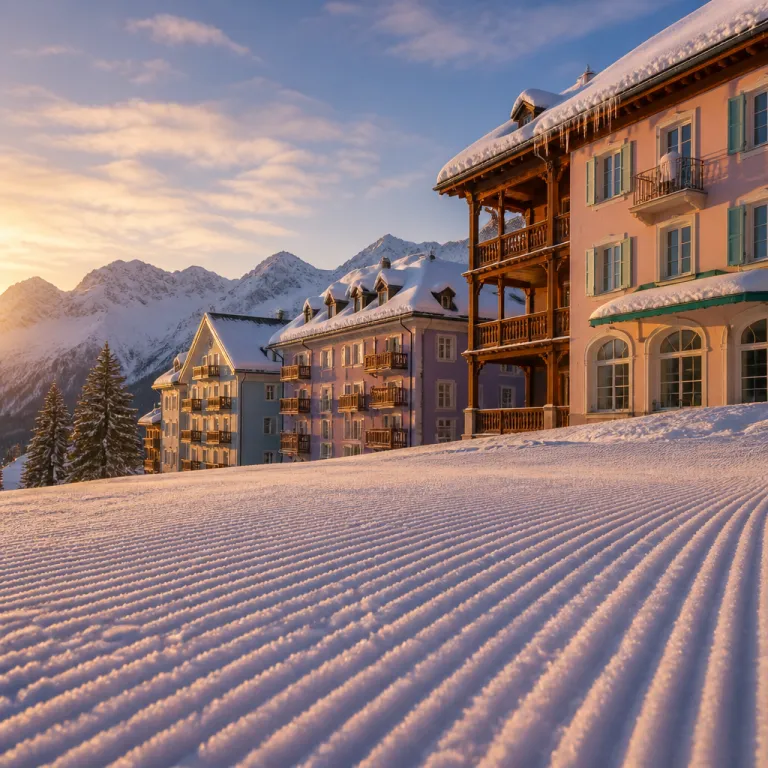
Where winter tourism was invented
A wager started it all. An innkeeper bet four English guests that the Engadin winter could rival an English summer. They arrived before Christmas. They stayed until Easter. And they brought friends the following year, setting in motion a tradition that turned a village at nearly two thousand metres into the most storied mountain resort on the planet.
The Upper Engadin valley stretches from the Maloja Pass to Zuoz, a corridor of frozen lakes, Romansh-speaking hamlets, and peaks that climb past four thousand metres on the Bernina massif. Somewhere along this valley, every serious skier, every cross-country purist, every traveller who craves thin air and golden light eventually arrives. The question is never whether St. Moritz deserves a visit. The question is which version of the Engadin suits your temperament.
Corviglia and the champagne climate
The ski terrain rises directly from the village. One hundred and fifty-five kilometres of piste reach the Piz Nair summit above three thousand metres, where the panorama stretches across the lake chain to the Bernina massif. The runs suit confident intermediates and strong skiers alike, long sweeping descents above the treeline where the snow stays dry and cold under what the locals call a champagne climate: three hundred days of sunshine a year, crisp air, and a sky so blue it almost hurts.
The Corviglia sector feels different from the heavy snowfall resorts of the western Alps. Here the grooming is impeccable, the visibility almost always reliable, and the light at altitude turns every descent into something cinematic. You can ski from the Piz Nair all the way down to the valley floor, pausing at a mid-mountain terrace where the frozen lake glints below like hammered silver. The vertical drop rewards patience. The terrain rewards technique over aggression.
Connect to the Corvatsch area from Silvaplana and the altitude pushes past thirty-three hundred metres, the highest lift-served point in the canton. The glacier skiing up there has a severity to it, a reminder that the mountains were here long before the funiculars and the heated boot rooms.
The frozen lake and everything it carries
When the lake freezes, the valley transforms. The ice grows thick enough to support horse racing, polo matches, and a cricket pitch that claims the altitude record for the sport. White Turf brings three Sundays of thoroughbred racing on the frozen surface, drawing tens of thousands of spectators who line the shore in fur and cashmere. Snow Polo fills the lake with international teams charging across a pitch chalked onto ice. These are not novelty events. They are traditions refined over generations, staged with the logistical confidence that comes from doing something extraordinary so many times it starts to feel routine.
From the hillside above the lake, the spectacle unfolds like a painting. Horses kicking up powder against a backdrop of snow-covered peaks. The sound of hooves on ice carries across the still air. There is something wonderfully absurd about it, and something genuinely moving. This is a place that takes winter seriously enough to play on it.
Pontresina: the mountaineers' valley
Five kilometres from St. Moritz, the mood shifts entirely. Pontresina guards the entrance to the Bernina valley, and the atmosphere here belongs to mountaineers, not socialites. The village has served climbers since the golden age of Alpinism, and the hotels reflect that heritage. Rooms are comfortable without theatrics. Restaurants serve food that fuels a day on the glacier rather than performing for an audience. Breakfast conversations turn on weather windows and crevasse conditions, not gallery openings.
The Morteratsch glacier trail takes less than two hours on foot, a walk through a landscape that teaches geological time more effectively than any textbook. Markers along the path note where the glacier stood in previous decades, each one a quiet indictment of what the mountains are losing. At the trail's end, the ice wall looms, cracked and blue-veined, magnificent despite its retreat.
The Diavolezza cable car lifts you to nearly three thousand metres, onto a platform facing four peaks above four thousand metres. The Piz Bernina, highest point in the Eastern Alps, anchors the panorama. Most visitors fall silent when the doors open. The scale of it demands that response.
Cross-country skiing here covers over two hundred kilometres of groomed trails across the valley floor, one of the largest Nordic networks in the Alps. The Engadin Skimarathon, a forty-two-kilometre race from Maloja to S-chanf, passes through and brings the energy of more than thirteen thousand participants from sixty nations. The Nordic skier is a different animal from the downhill skier: earlier mornings, larger appetites, and a particular satisfaction that comes from covering distance under your own power.
Sils, Silvaplana, and the quieter Engadin
At the southwestern end of the lake chain, Sils-Maria keeps a contemplative pace. Nietzsche spent seven summers here, walking the lakeshore where the idea of eternal return struck him beside a pyramidal rock at the edge of the water. The village still rewards walkers and thinkers. Fewer shops. Smaller properties. A relationship with the landscape that feels literary rather than recreational. If St. Moritz is the stage, Sils is the reading room.
Silvaplana, on the lake between Sils and St. Moritz, has earned a reputation among kitesurfers and windsurfers who chase the Maloja wind. Each afternoon, the wind funnels through the pass and transforms the lake surface. In summer, the sails dot the water like confetti. The village serves an active crowd, hikers and cyclists alongside the wind athletes, all of them drawn by the same thing: a landscape that rewards physical engagement.
Celerina sits between St. Moritz and Pontresina, close to the Cresta Run course and within easy reach of every ski area and trail network in the valley. It makes the most practical base for guests who refuse to choose sides between glamour and grit, offering good rooms at rates the premium addresses on either flank do not attempt. The Muottas Muragl funicular departs from nearby, climbing to a panoramic platform at nearly twenty-five hundred metres. The view south across the chain of frozen lakes, with the Bernina range rising behind, is widely considered the finest single viewpoint in the Engadin. At sunrise, when the peaks catch the first light and the valley remains in shadow, it justifies every early alarm.
Summer and the Bernina Express
When the snow melts, the valley reveals a different character. The hiking ranges from gentle lakeside paths to serious mountain routes through the car-free Val Fex, where streams tumble alongside the trail and the silence is broken only by cowbells and birdsong. The Engadine Golf Club at Samedan, founded before the twentieth century began, provides a summer activity that the frozen lake replaces in winter.
The Bernina Express railway earns its UNESCO World Heritage status over four hours, crossing from St. Moritz to Tirano in Italy across nearly two hundred bridges and through fifty-five tunnels. The route crests the Bernina Pass above twenty-two hundred metres before descending through the Mediterranean-influenced Poschiavo valley to the Italian border. In a single morning, the train traverses the full climatic range of the Alps. Pack a lunch for Poschiavo, eat Italian on the terrace, and return by the regular service. It ranks among the finest day trips available from any mountain base in Switzerland.
The Engadin light in summer deserves its own mention. At this altitude, the air is thin enough to sharpen every edge. Shadows cut clean. Colours saturate. Photographers and painters have chased this light for over a century, and guests who time their visit for the long days of July discover a visual intensity that the winter, for all its spectacle, cannot quite equal.
St. Moritz region at a glance
- Altitude: 1,856 m (St. Moritz village)
- Ski terrain: 155 km of piste, summit at Piz Nair (3,057 m)
- Corvatsch: highest point at 3,303 m, glacier skiing
- Cross-country: 220+ km groomed Nordic trails
- Diavolezza: 2,978 m platform facing the Bernina massif
- Muottas Muragl: 2,453 m panoramic viewpoint
- Bernina Express: UNESCO World Heritage railway to Italy
- Frozen lake events: White Turf, Snow Polo, Cricket on Ice
- Zurich: approximately 3 hours by car or rail
- Milan: approximately 4 hours via the Bernina route
Which village suits which traveller?
St. Moritz Dorf delivers the grand tradition, the social calendar, and the cultural density that a century and a half of luxury tourism has built. Pontresina suits the physically ambitious, the glacier curious, and the cross-country devoted. Sils rewards the contemplative guest. Silvaplana draws the wind athletes. Celerina offers the most balanced base, close to everything, committed to nothing except comfort and access. The valley is compact enough that every village reaches every experience within twenty minutes. The atmosphere, however, changes dramatically between them, and the choice of base determines which Engadin you discover.
When does the region reward most?
February brings the frozen lake events and the social peak. March delivers the Engadin Skimarathon and late-season snow in reliable condition. Summer opens the hiking, the Bernina Express, and the Engadin light at its sharpest. The shoulder months of June and October, when the lakes are liquid and the crowds thin, offer something rarer: the valley at its most honest, before or after the performance begins. Room rates in summer sit below winter levels across every village. Every season gives generously. The region has spent over a century and a half learning how.
Is the Cresta Run accessible to visitors?
The Cresta Run, a natural ice toboggan course that drops from St. Moritz to Celerina, accepts guest riders during the season. It requires a short instruction session and a willingness to lie face-first on a skeleton sled at speeds that make the heart rate climb faster than the funicular. The run has operated since the late nineteenth century and remains one of the most singular sporting experiences available in the Alps. It is not for everyone. It is unforgettable for those who try.
How does altitude affect the stay?
At nearly nineteen hundred metres, the air is noticeably thinner than at sea level. Most guests adjust within a day, though the first afternoon may bring a slight headache or unusual fatigue. Drink water. Take the first ski day gently. By the second morning, the altitude becomes an asset rather than a challenge: sharper air, deeper sleep, and a clarity of light that flatland visitors find almost intoxicating.