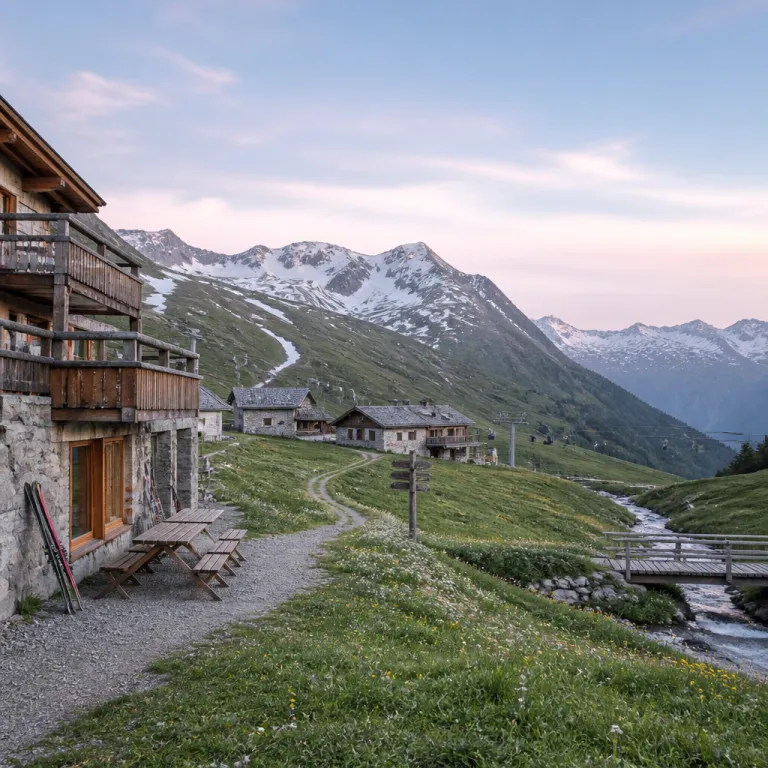
Hotels in the Surselva: Romansh Switzerland and the Rhine Gorge
The Surselva occupies the upper Rhine valley in the Canton of Graubunden, a region where the fourth Swiss national language, Romansh, is still spoken in the villages and where the landscape swings between forested gorges, open alpine meadows, and the kind of engineered ski terrain that Flims-Laax has developed into one of the most complete winter and summer destinations in the Alps. This is not the Switzerland of chocolate-box imagery. The place names carry a Latin musicality that reflects 2,000 years of mountain isolation: Muster for Disentis, Flem for Flims, Cuira for Chur. The hospitality runs warmer than the German-speaking cantons tend to deliver, with a conversational ease that reflects the Romansh tradition of welcoming the stranger who has crossed the pass.
Hotels in the Surselva range across an extraordinary spectrum. At one end, the contemporary design properties at Laax where freestyle skiers and snowboarders plan tomorrow's session over craft beer. At the other, the Benedictine monastery guesthouse at Disentis where monks have welcomed travellers since the eighth century. Between them, the thermal hotel at Vals where Peter Zumthor's quartzite baths have become one of the most celebrated works of contemporary architecture in Switzerland. The region asks a guest to decide not just where to sleep but what kind of mountain experience to inhabit, and the answer changes the stay completely.
Flims-Laax: freestyle culture and forest lakes
Flims and Laax sit above the Rhine valley at approximately 1,100 metres, connected by a ski area covering 224 kilometres of terrain that reaches 3,018 metres at the Vorab glacier. The resort has positioned itself as one of Europe's premier freestyle destinations: four snow parks, a halfpipe that hosts World Cup events, and a guest profile that skews younger and more creatively ambitious than the traditional Swiss ski village attracts. The hotels at Laax reflect this energy. The architecture is contemporary. The dining is flexible rather than formal. The common spaces function as planning rooms where tomorrow's line through the park gets sketched on napkins.
Flims provides the counterpoint. The village is older, quieter, and oriented toward the forest landscape that the Flimserstein plateau conceals above the Rhine valley. Lake Cauma sits in a forested crater formed by the Flims Rockslide, the largest landslide in the Alps at 10 cubic kilometres of displaced rock. The lake water reaches a turquoise so intense it looks artificially coloured. Swimming temperatures climb to 24 degrees from June through September. The surrounding old-growth forest filters the light into green columns that make the lake feel enclosed, private, almost subtropical despite the 1,000-metre altitude. Access is on foot only, through a tunnel carved in the rock, and the walk creates a threshold effect: the ordinary world stays on one side, Lake Cauma exists on the other.
The Conn viewpoint, a cantilevered platform extending over the Rhine Gorge, provides a perspective on the gorge that the valley floor does not suggest. The drop is vertical. The river runs turquoise 400 metres below. Guests who visit Flims for the skiing discover the summer landscape almost by accident, and often return for it specifically.
The Rhine Gorge: Switzerland's hidden canyon
The Ruinaulta stretches 13 kilometres through the valley between Ilanz and Reichenau, where vertical limestone walls rise 400 metres above the young Rhine. The gorge was carved 10,000 years ago when the Flims Rockslide dammed the river, created a lake, and the lake's eventual breach cut through the debris in a geological event whose scale the quiet valley conceals. Rafting through the gorge is the definitive Surselva experience. The river runs turquoise between walls of white rock. Golden eagles circle above. The silence, broken only by water and wind, feels prehistoric.
The Glacier Express railway runs along the gorge's northern edge, providing a window view that the rafting completes from below. Ilanz, the self-proclaimed first city on the Rhine, provides the most direct gorge access from its modest collection of riverside hotels. The hiking trails along the gorge rim offer the aerial perspective. The river provides the intimate one. Experiencing both, the hike one day and the raft the next, reveals the Ruinaulta as a landscape that rewards every angle.
Disentis: monastery and mountain
Disentis sits at 1,130 metres at the upper end of the Surselva, where the valley narrows toward the Oberalp Pass and the route to Andermatt. The Benedictine monastery, founded around 720 AD, has operated continuously for over 1,300 years. The monastery church, rebuilt in baroque style after fire destroyed it, dominates the town from its hilltop position with twin towers visible from every approach. The guesthouse welcomes visitors in the monastic hospitality tradition: simple rooms, substantial meals, and the particular quiet that a community organised around prayer maintains.
The Romansh language tradition is strongest here. The monastery served as the guardian of the language's written culture for centuries, and the conversation at the bakery, the greetings on the street, carry the cadence of a tongue spoken nowhere else on earth. The ski area above the town covers 60 kilometres of terrain to 2,833 metres, now connecting to the expanded Andermatt-Sedrun ski arena, which has added scale without altering the character of a village that feels genuinely remote. The Oberalp Pass, connecting the Surselva to the Gotthard region, provides the starting point for the Glacier Express journey to Zermatt and a scenic drive that crosses the linguistic border between Romansh and German Switzerland in a single hairpin.
Vals: architecture carved from the mountain
Vals sits in a side valley south of Ilanz, a small community of 1,000 residents that achieved international fame when Peter Zumthor completed the Therme Vals in 1996. The building is constructed from locally quarried Valser quartzite, assembled in horizontal layers that evoke the geological strata of the surrounding mountains. From certain angles, the structure appears to have grown from the hillside rather than been placed upon it. The thermal waters fill pools of varying depth and light at temperatures between 30 and 42 degrees. The bathing experience is closer to meditation than recreation. Sound dampens. The stone absorbs and radiates heat. The outdoor pool opens to a mountain panorama that the steam partially veils, creating an atmosphere where the boundary between architecture and landscape dissolves.
Hotels in Vals beyond the main thermal property serve guests at more accessible rates, and the village itself, at 1,252 metres in a valley that receives limited winter sun, provides the austere mountain atmosphere that Zumthor's architecture channels rather than contradicts. The contrast with the freestyle energy of Laax, 45 minutes to the north, could not be more complete. Guests who experience both within a single Surselva stay discover the full range of what this region contains, from half-pipe to thermal pool, from snowboard park to quartzite bath.
Chur: the oldest city and the regional gateway
Chur sits at 585 metres at the northern entrance to the Surselva. Archaeological evidence confirms continuous settlement for over 5,000 years, making it the oldest city in Switzerland. The old town is compact and pedestrian, with restaurants, independent shops, and the kind of urban base that the mountain resorts above do not offer. The drive to Flims takes 20 minutes. Disentis is one hour. The Rhaetian Railway, connecting to Davos, St. Moritz, and the Glacier Express, departs from Chur station. Guests who want mountain access alongside the pleasures of a small Swiss city, a glass of Graubunden Pinot Noir at an outdoor table, a morning in a gallery, a meal that does not involve raclette, find Chur an underrated base.
Getting to the Surselva
Zurich connects to Chur in approximately 1.5 hours by train. The Rhaetian Railway continues from Chur through the entire Surselva to Disentis, where it connects at Andermatt to the Gotthard route. The Glacier Express, running from Zermatt to St. Moritz, passes through the Surselva via Disentis and the Rhine Gorge, making the railway journey itself one of the great scenic approaches to any mountain hotel destination in Europe. Driving provides flexibility for reaching Vals and the side valleys, but the train network covers the main corridor with the reliability that Swiss public transport maintains as a point of national pride.
Surselva hotel figures
- Flims-Laax: 224 km ski terrain, Vorab glacier at 3,018 m, 4 World Cup-standard snow parks
- Lake Cauma: turquoise forest swimming lake, 24 degrees in summer, foot access only
- Rhine Gorge (Ruinaulta): 13 km canyon, 400 m vertical limestone walls, rafting and rim hiking
- Disentis Monastery: Benedictine foundation circa 720 AD, over 1,300 years of continuous operation
- Therme Vals: Peter Zumthor 1996, Valser quartzite, thermal waters 30 to 42 degrees
- Chur: 585 m, oldest Swiss city, 5,000 years of continuous settlement
- Zurich to Chur: 1.5 hours by train; Chur to Flims: 20 minutes by car
What guests ask about Surselva hotels
What makes the Surselva different from other Swiss Alps regions?
The Romansh language, spoken by approximately 60,000 people in five regional dialects and existing nowhere else on earth, gives the Surselva a cultural identity that no other Swiss region shares. The Rhine Gorge provides a geological spectacle unique in Switzerland. The Therme Vals provides an architectural experience unmatched in the Alps. And the Flims-Laax freestyle culture creates a winter sports atmosphere that traditional Swiss ski villages do not attempt. The combination of linguistic heritage, natural drama, and contemporary mountain culture rewards guests who reach the Surselva with a depth that the more famous Swiss destinations have polished away.
Can guests combine Laax skiing with the thermal baths at Vals?
The drive from Laax to Vals takes approximately 45 minutes through the Rhine valley. A morning on the slopes followed by an afternoon in the thermal pools is a realistic and rewarding day. Alternatively, splitting a Surselva stay between a few nights at Laax and a few at Vals provides the full contrast: freestyle energy against meditative stillness, contemporary design against quartzite and thermal water. The two experiences complement each other precisely because they share nothing in common except the mountain landscape.
Is the Surselva accessible without a car?
The main valley from Chur to Disentis is served by the Rhaetian Railway, one of the most scenic rail corridors in Switzerland. Flims and Laax connect to Chur by regular PostBus. Vals, in its side valley, is reachable by PostBus from Ilanz. The connections are reliable and timed, as Swiss public transport standards require. A car adds flexibility for reaching the more remote viewpoints and gorge access trails, but a car-free Surselva stay centred on the main valley is entirely practical.
When is the best time to visit the Surselva?
Winter, from December through April, delivers the Flims-Laax skiing and the Disentis-Andermatt connection at their best. Summer, from June through September, opens Lake Cauma for swimming, the Rhine Gorge for rafting, and the hiking trails across the high meadows. The shoulder months of May and October are quieter and less expensive, though some mountain facilities close. The Therme Vals operates year-round and is particularly atmospheric when snow covers the valley and steam rises from the outdoor pool into cold mountain air.