Ski Hotels in Tignes: Where the French Alps Meet the Glacier
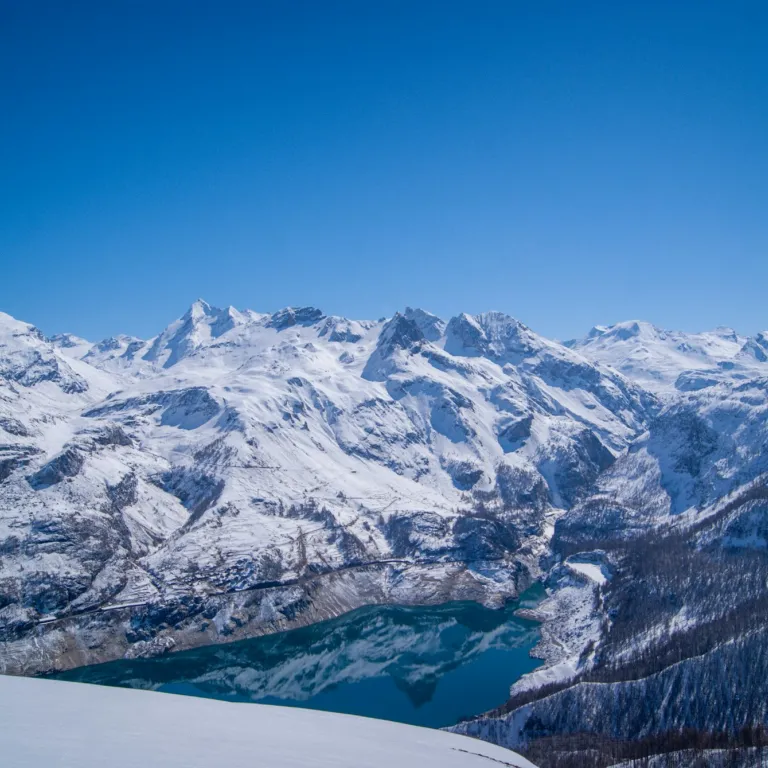
Tignes occupies a peculiar position in the hierarchy of French Alpine ski resorts. It lacks the village charm of its neighbour Val d Isere. It will never win awards for architectural beauty. And yet, for a certain kind of skier, Tignes is simply the best place to be. The altitude guarantees snow when lower resorts are praying for it. The Grande Motte glacier extends the season into territory that other resorts cannot touch. And the ski area, shared with Val d Isere across the vast Espace Killy, delivers 300 kilometres of terrain that ranges from gentle nursery slopes to steep couloirs that will test anyone.
Where to stay nearby
Choosing where to stay in Tignes means choosing which version of the resort speaks to you. This is not a single village but a collection of settlements stacked at different altitudes, each with its own character, its own relationship to the mountain, and its own answer to the question of what a ski holiday should feel like.
Understanding the Villages of Tignes
Tignes is organised vertically rather than horizontally, which is unusual among major French ski resorts. The villages climb from Les Brevieres at 1,550 metres through Tignes 1800 (also called Les Boisses), up to Le Lavachet at 2,050 metres, Tignes Le Lac at 2,100 metres, and finally Val Claret at 2,150 metres. This altitude range has practical consequences that shape every aspect of a stay.
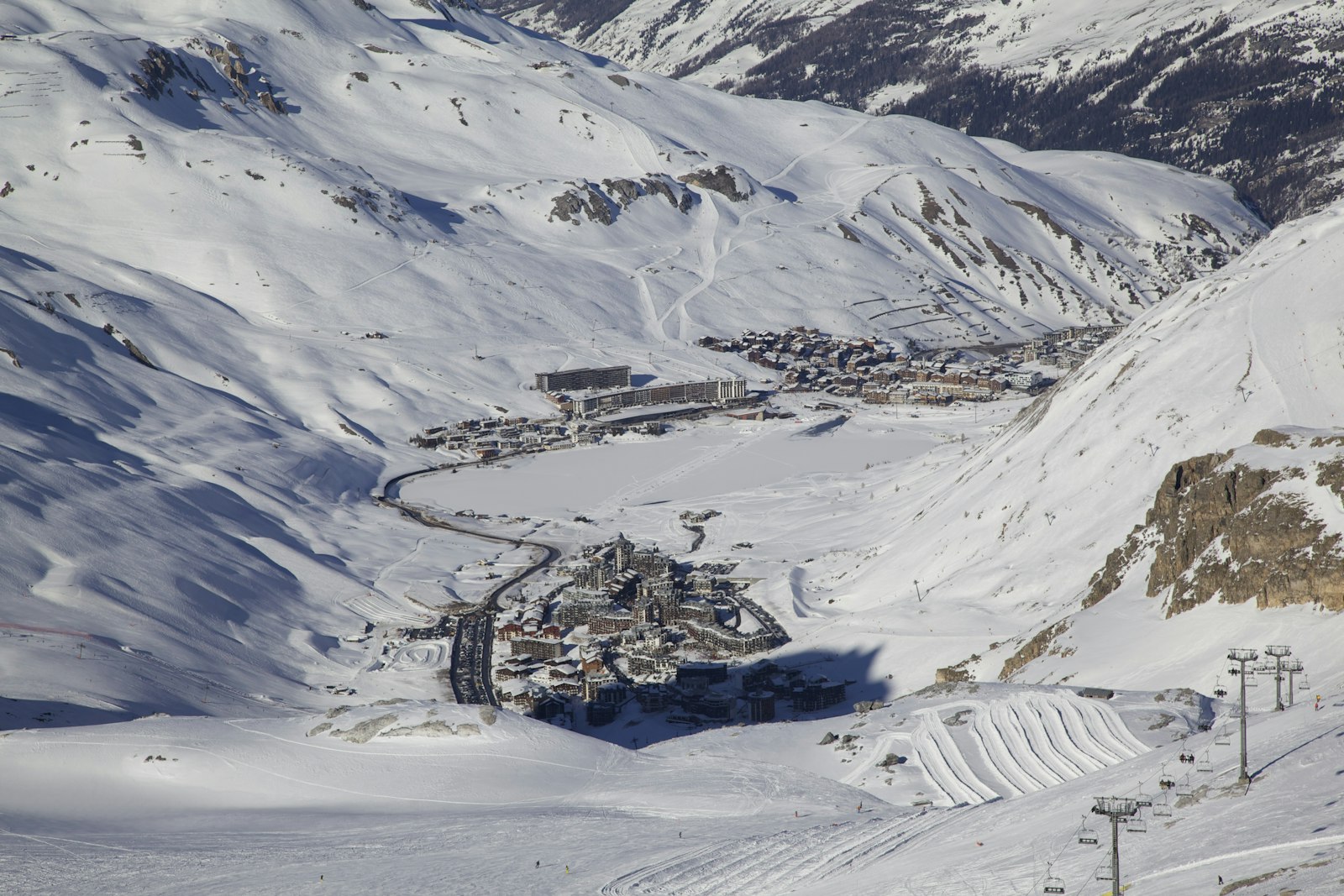
The villages of Tignes stacked around the frozen lake, seen from the slopes — photo Gaspard Guillod / Unsplash
Tignes Le Lac is the historical and social centre of the resort. It sits beside the lake that gives it its name, frozen solid through winter and ringed by walking paths in summer. The atmosphere here is the most balanced of the Tignes villages: close enough to the lifts for convenience, established enough to offer restaurants and bars with genuine personality, and positioned perfectly for guests who want the feel of staying in an actual mountain community rather than a purpose-built ski station.
Val Claret sits at the top of the resort and functions as the gateway to the Grande Motte glacier. This is where the funicular departs for high-altitude skiing that continues well into spring, and it is the village of choice for committed skiers who want maximum vertical and minimum fuss. The atmosphere skews younger and more energetic than Tignes Le Lac, with a lively apres ski scene and accommodation that tends toward the functional rather than the luxurious.
Tignes 1800 and Les Brevieres: The Quieter Alternative
Below the main resort, Tignes 1800 and Les Brevieres offer something increasingly rare in French Alpine skiing: a sense of genuine village life. Les Brevieres in particular retains the feel of a traditional Savoyard hamlet, with stone buildings and a pace that belongs to a different era. The skiing access is good, the accommodation is typically quieter and more spacious, and the evening atmosphere rewards those who prefer a glass of local wine by a fireplace over a crowded bar.
These lower villages also serve as the starting point for some excellent intermediate runs that descend through the trees, a feature that the higher, more exposed terrain above Tignes Le Lac and Val Claret cannot offer. On poor visibility days, which happen regularly at this altitude, the ability to ski through forest cover becomes a genuine advantage.
The Grande Motte Glacier: Skiing Above the Clouds
The Grande Motte glacier is the single feature that elevates Tignes from excellent ski resort to something genuinely extraordinary. Rising to 3,456 metres, it is accessed via a funicular from Val Claret followed by a cable car that deposits skiers onto a frozen landscape where the air is thin and the views extend across the entire chain of the western Alps.
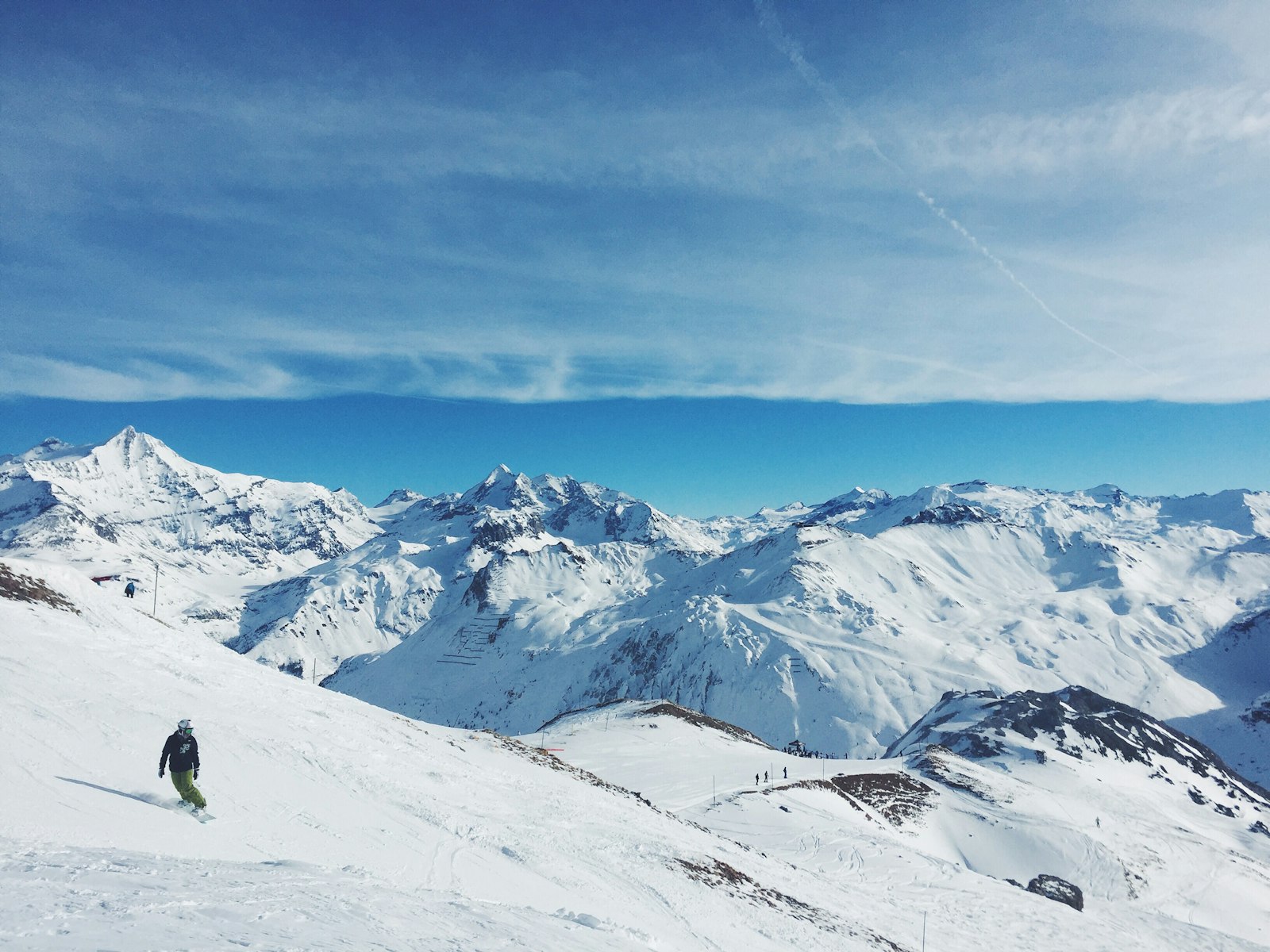
Riding above the clouds on the Grande Motte — photo Robert Bye / Unsplash
In winter, the glacier provides the highest skiing in the Espace Killy, with runs that are reliably covered in natural snow from November through May. The terrain is predominantly wide and open, suited to intermediate skiers who enjoy the sensation of carving turns at altitude with nothing but sky above and the Tarentaise valley spread out impossibly far below.
What makes the Grande Motte truly exceptional, however, is summer skiing. Tignes is one of a handful of European resorts that offer skiing between June and August, and the experience is unlike anything available in winter. The morning sessions on the glacier give way to afternoons spent hiking, mountain biking, or swimming in the lake at Tignes Le Lac, creating a rhythm of activity that captures the best of both seasons in a single day.
The Espace Killy: Scale That Rewards Exploration
The Espace Killy ski area combines Tignes and Val d Isere into a connected domain of more than 300 kilometres of marked runs served by over 90 lifts. For guests staying in Tignes, this means that a week of skiing barely scratches the surface of what is available. The terrain varies enormously: from the wide, above-treeline bowls above Val Claret to the steep, shaded runs through the forest of Le Fornet on the Val d Isere side.
The connection between Tignes and Val d Isere runs over the Toviere ridge, and the transition from one resort to the other happens almost seamlessly. Skiers can leave their accommodation in Tignes Le Lac after breakfast and be skiing the Face de Bellevarde in Val d Isere within an hour, then return via a different route through the Col de Fresse for an entirely different perspective on the same vast ski area.
Lift infrastructure in the Espace Killy has been consistently upgraded, with high-speed detachable chairlifts and gondolas reducing queue times to levels that would have seemed impossible a decade ago. For guests who have experienced the frustrations of overcrowded lift systems at other major ski areas, this efficiency is one of the genuine pleasures of skiing from Tignes.
Summer in Tignes: Beyond the Glacier
Tignes has invested heavily in its summer offering, and the result is a resort that functions year-round with a conviction that few high-altitude ski stations can match. The Grande Motte glacier provides summer skiing in the mornings, but the real breadth of the summer experience lies elsewhere.
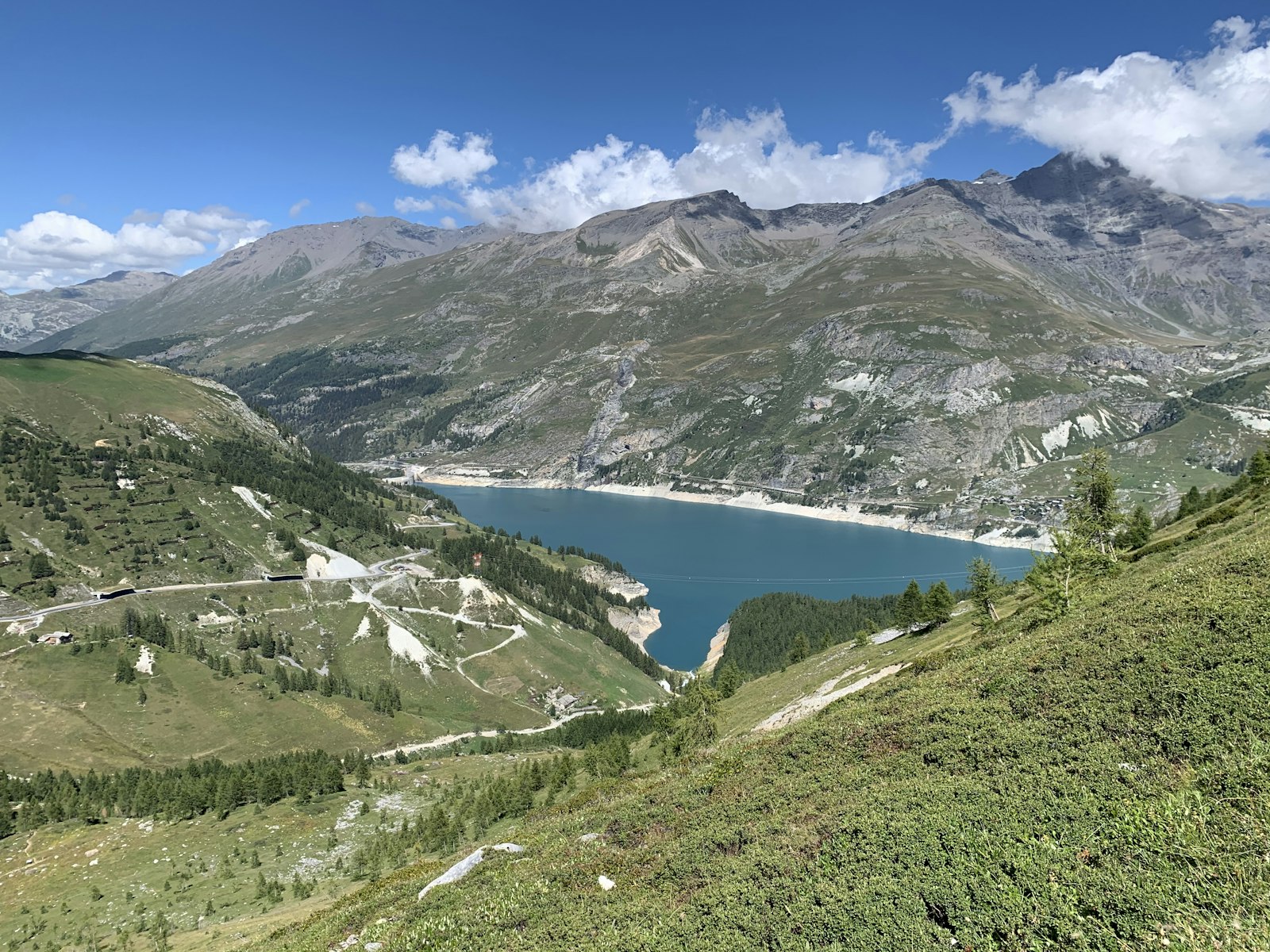
Summer in Tignes: the turquoise Lac du Chevril below the resort — photo Caroline M. / Unsplash
The Vanoise National Park borders Tignes to the south, and the hiking trails that radiate from all of the resort villages lead into some of the most pristine alpine landscape in France. The terrain above Tignes Le Lac opens into high-altitude meadows carpeted with wildflowers in July, with marmots whistling from the boulder fields and the occasional ibex silhouetted against the ridgeline. These are not gentle lakeside strolls. The altitude starts at over 2,000 metres, and the routes climb from there.
Mountain biking has become a major draw, with Tignes offering over 220 kilometres of dedicated trails that range from flowing cross-country routes to genuine downhill runs served by the resort lifts. The bike park attracts riders from across Europe, and the combination of high altitude, long descents, and reliable summer weather makes Tignes one of the premier mountain biking destinations in the Alps.
The Lake and the Rhythm of Summer Days
The lake at Tignes Le Lac becomes the social centre of the resort in summer. Swimming, paddleboarding, and lakeside dining replace the winter routine of lifts and ski boots, and the atmosphere shifts from athletic intensity to something more relaxed and contemplative. The lake sits at over 2,000 metres, which means the water is never warm, but on a hot summer afternoon the combination of cold water and mountain air is genuinely invigorating.
For guests staying in accommodation near Tignes Le Lac, the summer day develops its own rhythm. Early morning skiing on the glacier gives way to a late breakfast, followed by a hike or bike ride in the afternoon, and the day closes with dinner at one of the lakeside restaurants where the sunset colours the surrounding peaks in shades of orange and violet. It is a pattern that guests find addictive, and it explains why Tignes has built a loyal summer following that has nothing to do with snow.
Choosing Where to Stay in Tignes
Accommodation in Tignes tends toward apartments and self-catered residences, which reflects the resort's practical, skier-focused identity. There are conventional hotel properties, particularly in Tignes Le Lac and Val Claret, but the majority of visitors opt for the flexibility and space that apartment accommodation provides, especially for families and groups.
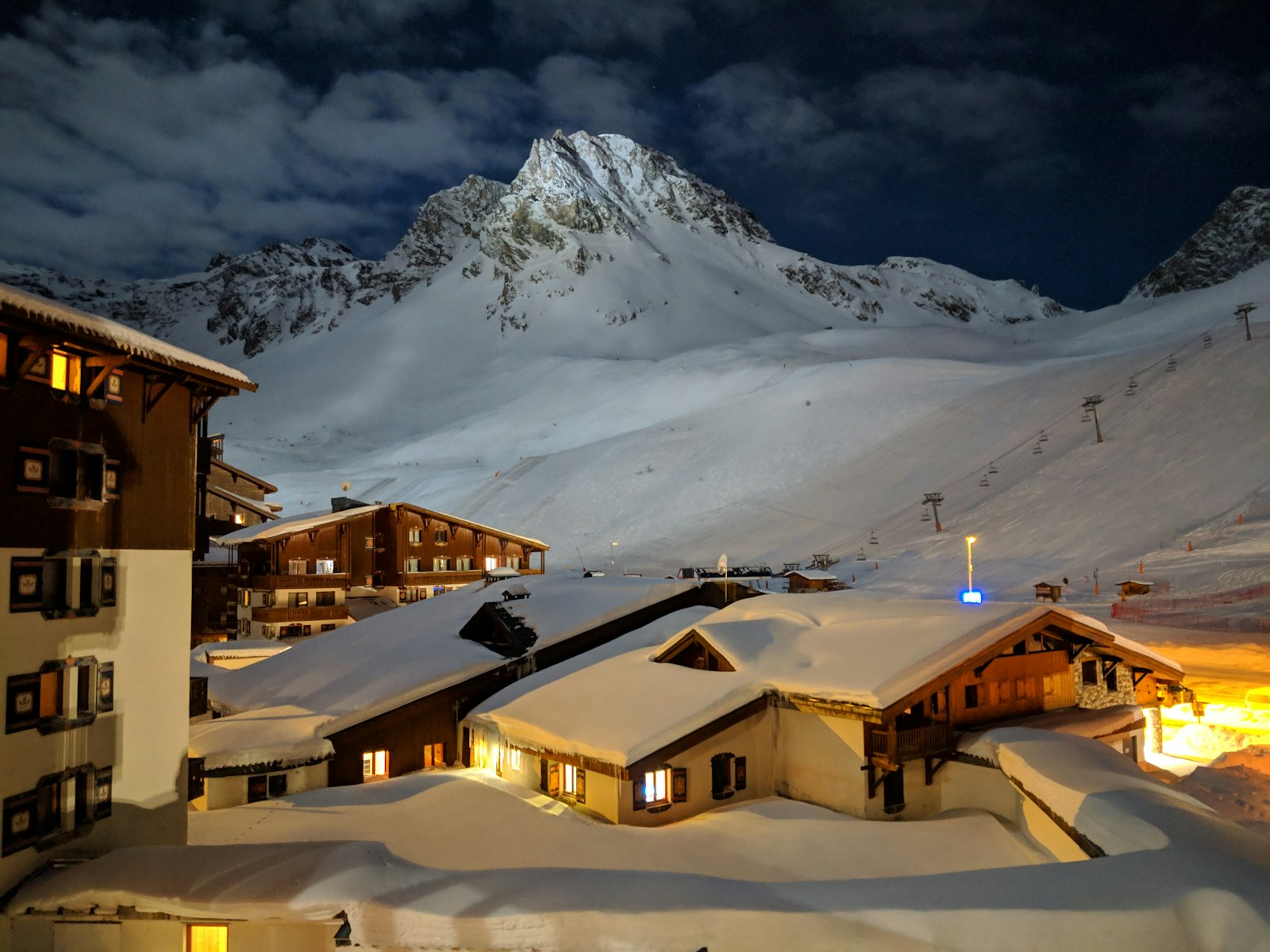
Hotels and chalets under the snow, Tignes by night — photo David Magalhães / Unsplash
The higher villages of Val Claret and Le Lavachet offer the most convenient ski access. Properties here tend to be ski-in, ski-out or very close to it, and the proximity to the funicular makes them the obvious choice for anyone whose primary interest is the Grande Motte glacier. The trade-off is a somewhat utilitarian atmosphere and a limited selection of restaurants and shops compared to Tignes Le Lac.
Tignes Le Lac provides the best overall balance. The accommodation stock includes everything from studios to substantial chalets, the village has enough restaurants and bars to sustain a week of varied evenings, and the position beside the lake gives it a visual anchor that the other villages lack. The lifts are a short walk rather than a step outside the door, which is a minor inconvenience that most guests accept in exchange for a more complete village experience.
What to Expect from Tignes Accommodation
Tignes does not pretend to be a luxury destination in the way that Courchevel or Megeve does, and there is something refreshing about that honesty. The accommodation is comfortable, often recently renovated, and oriented toward guests who plan to spend most of their time on the mountain rather than in their room. Facilities typically include access to a residence pool and spa area, ski storage, and parking.
The resort has been gradually upgrading its accommodation stock, and newer residences in Tignes Le Lac and Val Claret offer a noticeably higher standard than the older apartment buildings that still dominate parts of the resort. These newer properties feature better insulation, modern kitchens, and balconies oriented toward the mountain views that are the real luxury of staying at this altitude.
Dining in Tignes has improved considerably. Tignes Le Lac now has several restaurants that would hold their own in any Alpine resort, with cooking that draws on the Savoyard tradition of rich, warming dishes built around local cheeses, cured meats, and seasonal ingredients from the Tarentaise valley. For guests who want a proper restaurant experience rather than self-catering, Tignes Le Lac is the clear choice.
Getting to Tignes and Practical Matters
Tignes is accessed primarily through Bourg-Saint-Maurice, which connects to the TGV rail network and sits at the base of the valley road. The nearest airports are Chambery, Grenoble Alpes Isere, Lyon, and Geneva, with transfer times ranging from two to four hours depending on conditions. Private shuttle and taxi services are widely available, and the resort operates a free shuttle bus between all Tignes villages throughout the season.
The altitude of Tignes brings consequences that guests should understand before arriving. Above 2,000 metres, the sun is fierce and the air is dry. Hydration matters more than at lower resorts. The cold can be intense, particularly on the Grande Motte glacier, where temperatures regularly drop well below minus fifteen even on sunny days. None of this is a problem with appropriate preparation, but it shapes the experience in ways that first-time visitors sometimes underestimate.
For skiers and summer adventurers who value substance over style, snow reliability over village prettiness, and access to terrain that ranges from glacier to forest, Tignes delivers with a directness that is hard to find elsewhere in the French Alps. It is not trying to be everything. It is trying to be the best version of what a high-altitude mountain resort can be. And on that measure, it succeeds.