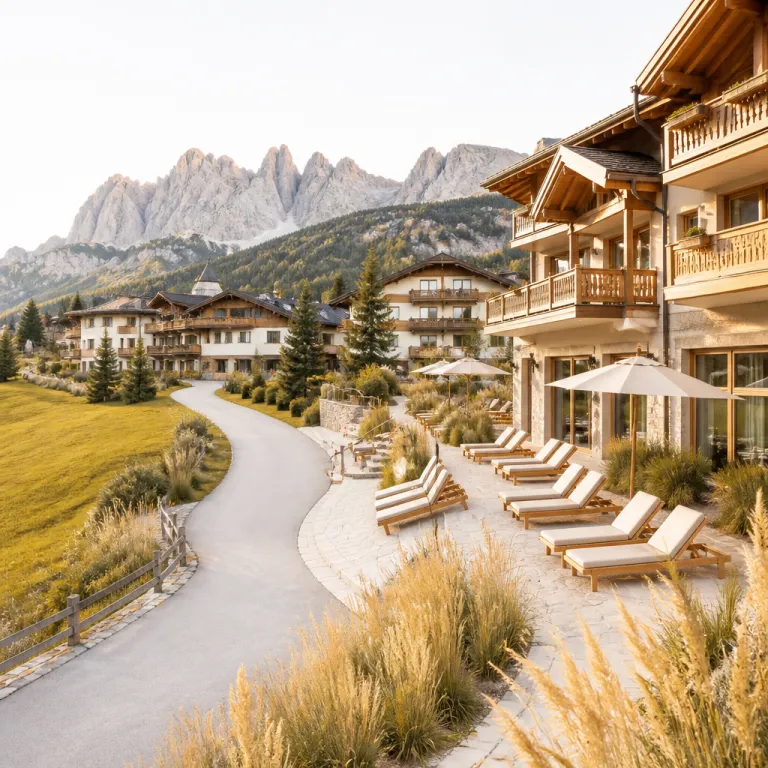
La Villa in Alta Badia, a Ladin Village at the Foot of the Dolomites
Tucked into the folds of Val Badia at 1,433 metres above sea level, La Villa occupies one of those positions in the Dolomites that feel almost strategically perfect. The village sits at the foot of Gardenaccia and Piz La Ila, framed by pale rock walls that change colour with each passing hour. It is small, home to roughly 1,164 inhabitants, most of whom still speak Ladin among themselves. That linguistic detail matters. La Villa is not a resort that happens to sit in the mountains. It is a Ladin village that happens to welcome travellers, and the distinction shapes everything from the food on the table to the rhythm of daily life.
Alta Badia as a whole draws skiers and hikers in considerable numbers, yet La Villa retains a quieter character than neighbouring Corvara or San Cassiano. The village centre sits directly beneath the Gran Risa slope, one of the most technically demanding runs on the FIS Alpine Ski World Cup circuit, which gives La Villa a certain sporting credibility without the sprawl that often accompanies competition venues. Hotels here tend to reflect that balance: serious about hospitality, steeped in local tradition, and refreshingly unbothered by pretension.
Why the Village Works as a Base for the Dolomites
The appeal of La Villa as a hotel destination rests on geography. The Piz La Ila cable car station lies within walking distance of the resort centre, providing direct access to the 130 kilometres of groomed slopes that make up the Alta Badia ski area. From there, skiers can connect seamlessly to the Sella Ronda circuit, the legendary loop that links Arabba, Selva, Val di Fassa, and the Marmolada glacier area across four high passes. Few villages in the Dolomites offer that level of connectivity without requiring a car or shuttle to reach the first lift.
In summer the equation shifts but the logic holds. La Villa stands between the Puez-Odle Nature Park and the Fanes-Sennes-Braies Nature Park, both protected UNESCO World Heritage areas. The trail from Capanna Alpina to Rifugio Fanes, one of the defining day hikes of the eastern Dolomites, begins a short drive away. Closer to the village, the Armentara meadows offer gentler walking through wildflower pastures that feel untouched despite their proximity to established paths. The mountains here are not scenery. They are the reason the village exists.
The Character of Hotels in La Villa
Accommodation in La Villa ranges from traditional garni guesthouses to well-appointed four-star hotels, but a common thread runs through most of them: an orientation toward the mountains rather than toward spectacle. Many properties are family-run operations that have evolved over generations, adding wellness areas and modernised rooms without abandoning the warmth that defined them from the start. Half board remains a standard offering, and it tends to be worth accepting. The kitchens in La Villa draw on Ladin culinary traditions that blend South Tyrolean heartiness with a lightness inherited from proximity to the Veneto.
Hotels near the resort centre benefit from that proximity to Piz La Ila and, by extension, to the Gran Risa slope. Watching World Cup racing from a hotel terrace is a genuine possibility here, not a marketing claim. Properties positioned slightly above the village often trade ski-in convenience for panoramic views across the valley toward the Conturines and Lavarella peaks, a trade-off that many returning guests consider worthwhile.
The garni format deserves particular mention. These smaller establishments operate as bed-and-breakfast hotels, typically offering fewer than twenty rooms and a generous morning spread that leans heavily on local dairy, cured meats, and fresh-baked bread. For travellers who prefer to eat dinner at a mountain hut or village restaurant rather than in a hotel dining room, a garni in La Villa represents an intelligent and often more affordable choice.
Winter in La Villa, Beyond the Gran Risa
The Gran Risa slope dominates the conversation about skiing in La Villa, and rightly so. The run drops steeply from the Piz La Ila area directly into the village, with a gradient that tests even accomplished skiers. Each December, the Alpine Ski World Cup giant slalom transforms the slope into a competitive arena watched by thousands from the finish area. The atmosphere on race day is particular to this village. Spectators arrive early, many on foot from their hotels, and the combination of elite sport and intimate setting is something that larger resorts struggle to replicate.
Beyond the Gran Risa, the Alta Badia ski area caters generously to intermediate skiers. Wide, well-groomed runs connect La Villa to San Cassiano, Corvara, and Colfosco without demanding advanced technique. The apres ski scene here is measured rather than raucous. A glass of local wine at a sun terrace, a plate of casunziei or schlutzkrapfen at a mountain hut, and the slow walk back to the hotel as the light fades from the peaks.
The Sella Ronda circuit adds a dimension that extends well beyond Alta Badia. Completing the full loop in a single day requires moderate fitness and a willingness to start early, but the reward is a tour through four distinct valleys with views that shift from the pale towers of the Sella group to the glacial flanks of the Marmolada. Hotels in La Villa often help guests plan the route, arranging early breakfast and providing trail maps that account for lift schedules and mountain hut stops.
Summer, the Mountains on Foot
La Villa in summer operates at a different pace, but the underlying quality remains. Lifts reopen for hikers and mountain bikers, providing access to high-altitude trails that would otherwise require long approach walks. The Fanes-Sennes-Braies Nature Park, accessible from several trailheads near the village, contains some of the most remarkable landscape in the eastern Dolomites. Towering rock walls give way to hidden plateaux, alpine lakes surface in unexpected hollows, and the geological complexity of the terrain reveals itself with every change in elevation.
The Armentara meadows, lying just above La Villa, offer a contrasting experience. These protected grasslands bloom extravagantly between June and August, and walking through them requires no technical skill, only a willingness to move slowly. The meadows connect to trails leading toward Santa Croce, a small church perched improbably on a mountainside shelf that has served as a pilgrimage site for centuries.
Mountain biking routes radiate from the village into the surrounding valleys, with trails ranging from gentle forest roads to demanding single-track descents. Hotels in La Villa have adapted to this demand with secure bike storage, washing stations, and in some cases partnerships with local guides who know the trail network intimately.
Ladin Culture and the Table
The Ladin identity of La Villa is not folklore maintained for visitors. It is a living culture with its own language, traditions, and calendar of events. The Museum Ladin, located in nearby San Martino, traces the history of the Ladin people from prehistoric settlements through centuries of life shaped by isolation and altitude. In La Villa itself, cultural events punctuate the year: traditional farmer weddings, storytelling evenings in Ladin, and seasonal food celebrations that draw on recipes passed down through families.
The food in La Villa reflects this heritage with specificity. Turtres, deep-fried pastry pockets filled with spinach or sauerkraut, appear on nearly every menu as a starter. Cajincei, a local variation of filled pasta, vary from kitchen to kitchen depending on whether the filling favours ricotta, poppy seeds, or beetroot. The breads are exceptional, particularly the dense, dark rye loaves that accompany most meals. These are not dishes assembled for effect. They are the product of a cuisine shaped by climate, altitude, and a preference for substance over appearance.
Hotels that offer half board in La Villa typically integrate these traditions into their evening menus, alternating Ladin dishes with broader South Tyrolean and Italian preparations. The result is a culinary experience that feels rooted without being repetitive. Guests who prefer to eat out will find mountain huts along the trails above the village serving lunch with the same commitment to local ingredients, and a handful of village restaurants open in the evening with menus that reward curiosity.
Getting to La Villa and Getting Around
La Villa is reached most easily from Verona, Innsbruck, or Bolzano, each of which connects to the village by road through valleys that rank among the most scenic driving routes in the Alps. The nearest airports at Verona and Innsbruck sit roughly ninety minutes to two hours away by car, depending on traffic and season. Bolzano, the capital of South Tyrol, is closer and also accessible by train for travellers arriving from elsewhere in Italy or Austria.
Within the Alta Badia area, a network of ski buses operates efficiently during winter, connecting La Villa to San Cassiano, Corvara, Colfosco, and the other villages without requiring a car. In summer, the public bus network is supplemented by the Mobilcard system, which bundles public transport across South Tyrol into a single pass. Most hotels in La Villa include some form of transport pass in their room rate, a practical detail worth confirming at the time of reservation.
The village itself is compact enough to navigate on foot. Hotels near the centre place guests within a few minutes walk of restaurants, shops, and the Piz La Ila lift station. Those positioned on the slopes above the village offer quieter settings with valley views, accessible by a short drive or, in winter, by ski.
Who This Village Suits
La Villa works best for travellers who want the Dolomites experience without the scale and noise of a purpose-built resort. It suits skiers who value the Sella Ronda connection and the proximity to the Gran Risa World Cup slope. It suits summer hikers drawn to the Fanes-Sennes-Braies wilderness and the gentler meadow walks above the village. And it suits anyone with an interest in mountain culture that extends beyond the physical landscape to the language, food, and traditions of the people who have lived here for centuries.
Hotels in La Villa reflect these qualities. They are, for the most part, places run by families who understand that hospitality in the mountains means something specific: warmth without fuss, quality without ostentation, and a deep, instinctive connection to the landscape that sits outside every window. For the traveller willing to meet the village on its own terms, La Villa in Alta Badia offers one of the more honest and rewarding stays in the entire Dolomites region.