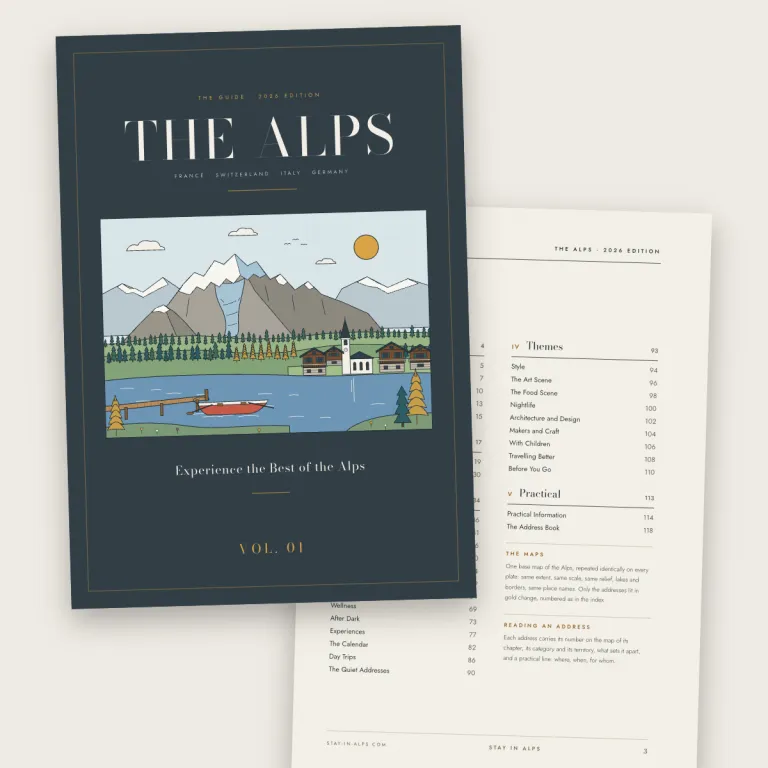
The Alps cross four countries, four languages and two currencies. From Chamonix to Berchtesgaden, the range is a string of valleys that do not share a table, a calendar or a way of welcoming guests. Our 2026 guide starts from that fact: you do not visit the Alps from one base, you choose a valley and you sleep there.
What is inside
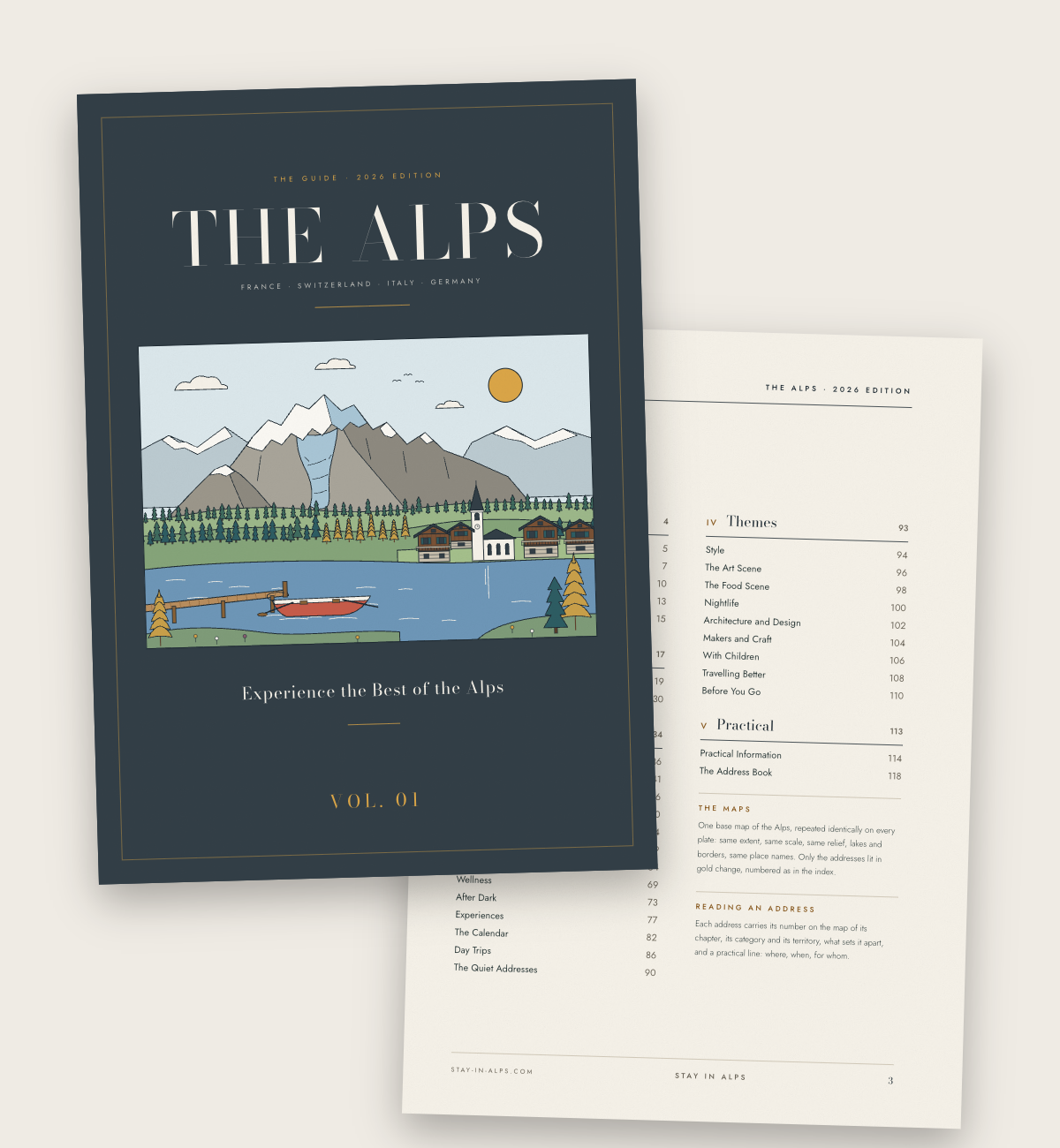
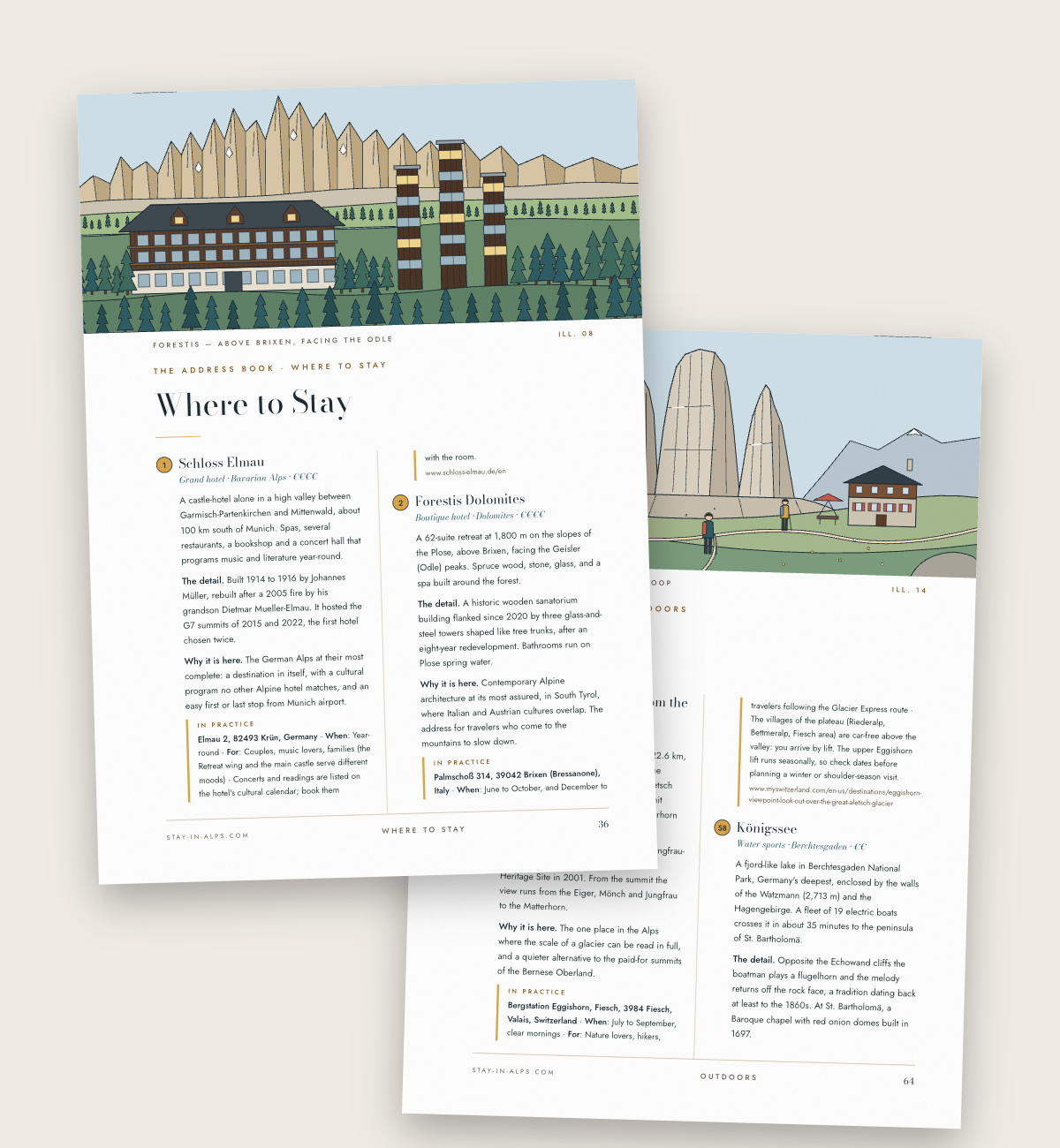
120 plates. 102 numbered addresses, from a castle-hotel that hosted the G7 twice to a mountain dairy turned refuge inside a natural park above Cortina. 21 maps. 30 illustrations. Three itineraries. Five parts: the opening, the territory, the address book, the themes and the practical section.
The address book is the heart of it: 10 addresses to stay, 12 to eat, 8 to drink, 6 for coffee and early hours, 10 for shopping, 10 for culture and heritage, 8 outdoors, 5 for wellness, 6 after dark, 8 experiences, 8 dates in the calendar, 6 day trips and 5 quiet addresses for travelers who already know the Alps.
Seven territories rather than one mountain range
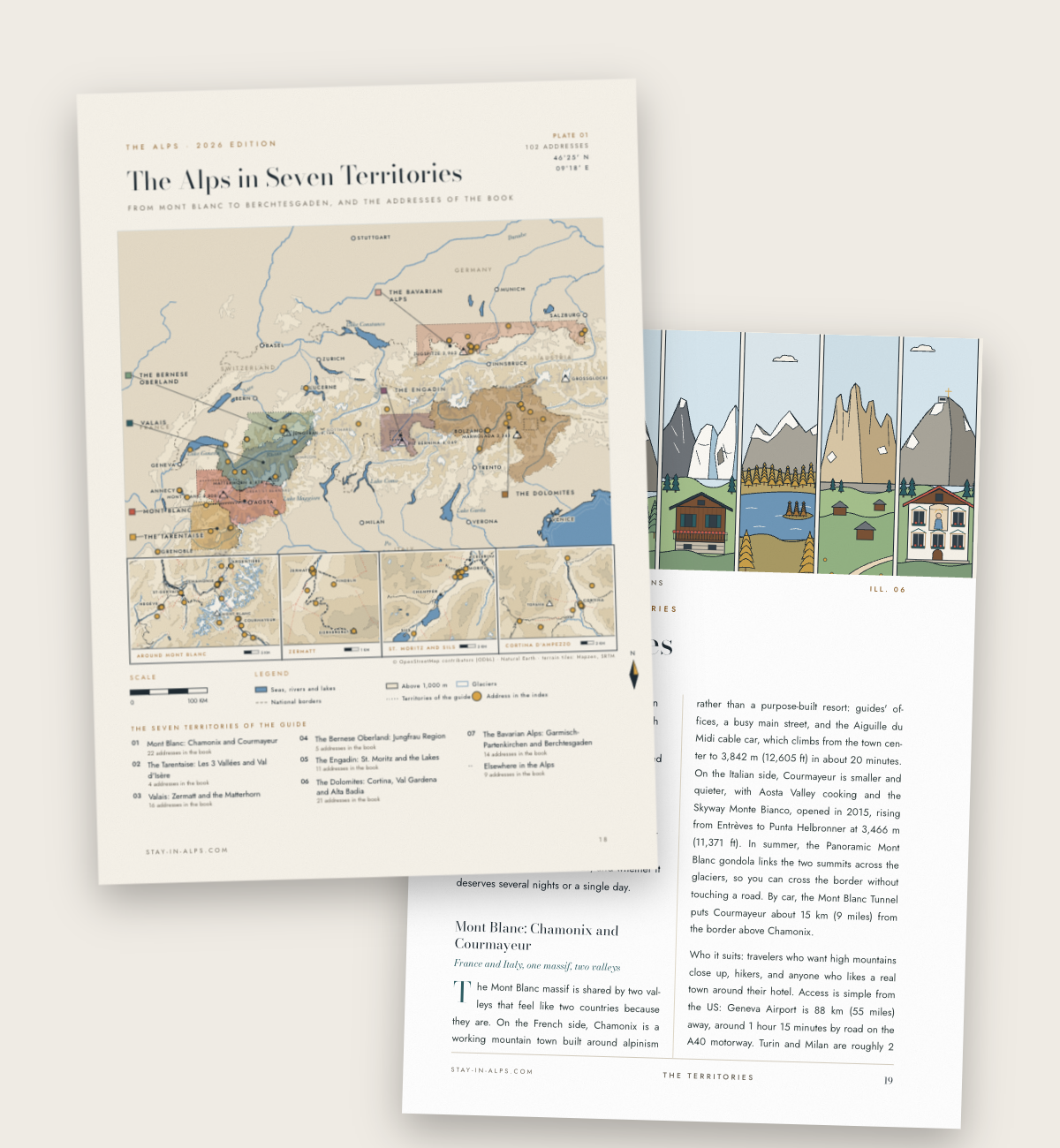
The guide divides the Alps into seven territories, each with its own rhythm and season: Mont Blanc with Chamonix and Courmayeur, the Tarentaise with Les 3 Vallées and Val d'Isère, Valais with Zermatt and the Matterhorn, the Bernese Oberland and the Jungfrau Region, the Engadin with St. Moritz and its lakes, the Dolomites with Cortina, Val Gardena and Alta Badia, and the Bavarian Alps with Garmisch-Partenkirchen and Berchtesgaden.
The addresses are spread the way they really are. Mont Blanc has 22, the largest share of the book, and the Dolomites 21. Valais has 16, the Bavarian Alps 14, the Engadin 11, the Bernese Oberland 5 and the Tarentaise 4. Nine more sit elsewhere in the Alps.
21 maps on a single base
Every map in the guide repeats the same drawing of the range: same extent, same scale, same relief, lakes and borders, same place names. Only the addresses lit in gold change, numbered as in the index. Four insets zoom in where the addresses cluster: around Mont Blanc, Zermatt, St. Moritz and Sils, and Cortina d'Ampezzo. One map shows all 102 addresses, others show each territory and each address chapter.
Every address says why it is there
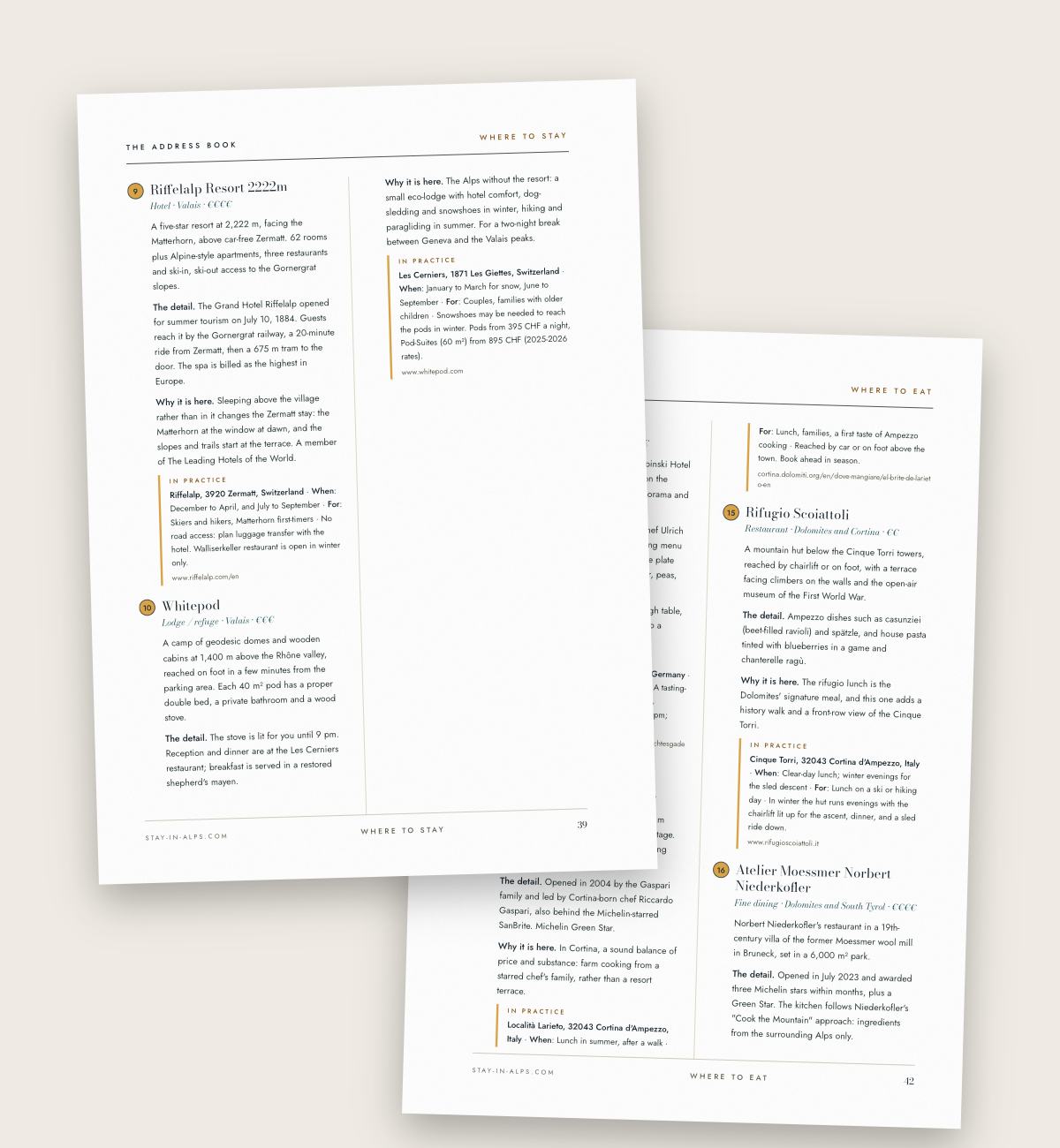
Each entry carries its number, its category, its territory, a detail that sets it apart and a line on why it is in the guide, then a practical block: where, when, for whom. Riffelalp Resort 2222m is there for where you wake up. It sits above car-free Zermatt, facing the Matterhorn, reached by the Gornergrat railway and then a 675 m tram to the door. The hotel opened for summer tourism on July 10, 1884. The guide adds that there is no road access, so the luggage transfer has to be arranged with the hotel.
The Königshaus am Schachen is in the quiet addresses for the opposite reason: you cannot get there easily. King Ludwig II's mountain retreat at 1,866 m has a gilded Turkish Hall upstairs, no road and no cable car. It takes 6 to 7 hours on foot up and back from Garmisch-Partenkirchen, which is exactly why it stays quiet while Neuschwanstein queues.
Three itineraries, from two days to ten
Three routes built only from addresses in the guide. Each one starts and ends at an airport with direct or one-stop flights from the United States.
Two days around Mont Blanc, from June to mid-September, flying into Geneva. Day one in Chamonix with the Aiguille du Midi, which climbs to 3,842 m, and a night at Hameau Albert 1er. Day two in Courmayeur, through the Mont Blanc Tunnel, with the Skyway Monte Bianco, lunch at Chalet del Miage in Val Veny and an aperitivo by the 15th-century fireplace of Caffè della Posta.
Five days by rail, Zermatt to the Engadine, with no car. The Gornergrat railway at first light, the Glacier Express from Zermatt to St. Moritz, Hotel Waldhaus Sils in Sils Maria, run by the same family since 1908, the Segantini Museum, then the Bernina Express to Tirano in Italy.
Ten days by car, Munich to the Dolomites, from late June to mid-September. Schloss Elmau and the Partnach Gorge, Neuschwanstein, Bolzano and a Tuesday wine tasting at Alois Lageder, Forestis above Brixen, Lago di Braies before 9 am, a night at Rifugio Lagazuoi and the Tre Cime di Lavaredo loop, then Venice airport.
A calendar that is Europe's, not yours
The guide dates what weighs on a trip. Christmas to New Year is the most expensive fortnight of the winter, and February is the second peak, when the French school breaks are staggered across three zones. Presidents' Day weekend 2027 lands in the fullest week of the French and Swiss season. The weeks that pay off for an American traveler are mid-January and mid to late March. In summer, the pressure point is mid-August in the Dolomites, around Ferragosto on August 15.
When to read it
Before you book rather than after. The guide says which weeks to aim for, which addresses are open in which season, and which reservations have to be made months ahead, from hut nights to the toll road to the Tre Cime. Its page gives access to the download. It opens in your browser, and it is free.