
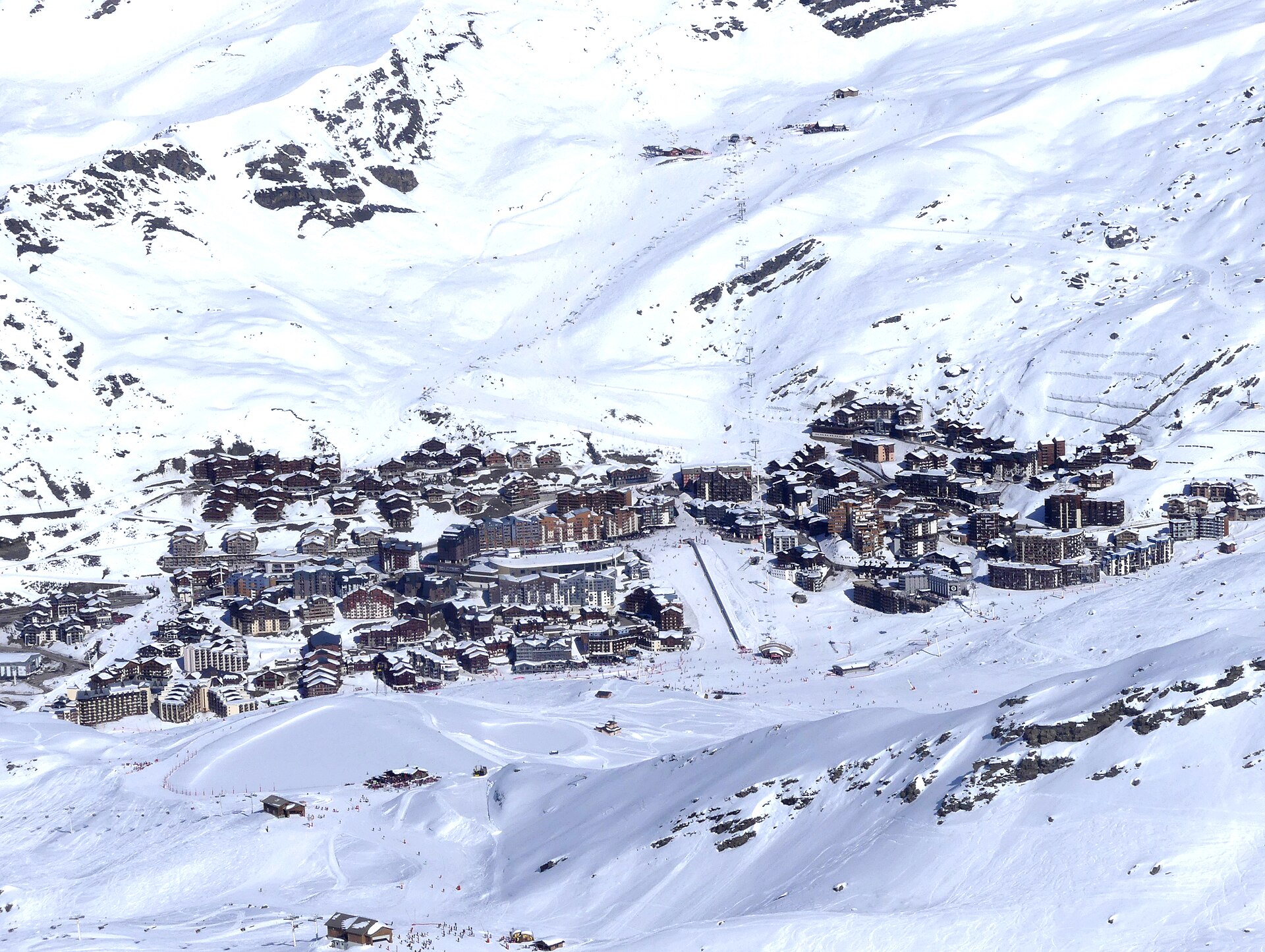
Val Thorens is the highest ski resort in Europe: a purpose-built station at 2,300 m at the head of the Belleville valley, where the season starts in November, ends in early May, and virtually every bed in the village is ski-in ski-out. It is also the high door into the 3 Vallées, the largest linked ski area in the world with around 600 km of runs.
| Zone | Character | Best for |
|---|---|---|
| Village slopes | Wide, gentle, sunny bowl | Beginners, warm-up runs, families |
| Cime Caron | The 3,200 m summit cable car | Steeps, views, cold snow |
| Péclet glacier | High, snow-sure terrain | Early and late season laps |
| Orelle (4th valley) | Quieter link over the ridge | Escaping peak-week crowds |
| Towards Méribel – Courchevel | The full 3 Vallées circuit | Strong intermediates on a mission |
Altitude as a strategy
Everything about Val Thorens follows from its height. The village bowl keeps its snow when lower resorts are scraping; the north-facing orientation preserves quality; and the links over to Méribel and Courchevel mean you ski the whole 3 Vallées from its most snow-sure corner. The skiing itself is mostly open, treeless and confidence-building — enormous groomed boulevards with genuine steeps off Cime Caron for those who want them.
Season: the longest in France
The lifts turn from late November to early May, and Val Thorens regularly opens when the rest of France cannot. Late-season skiing here is a specialty: April brings spring festivals, empty pistes and a village still fully open. The flip side is weather exposure — with no trees, storm days can shut the upper mountain, so build a flexible plan.
The village: purpose-built, and better for it
Val Thorens makes no pretence of being a farming hamlet. It is compact, pedestrian-friendly and engineered around convenience: you clip in outside your door and glide to the lifts. The dining and après scene has climbed steadily upmarket, from the legendary Folie Douce to serious mountain restaurants, and the resort consistently wins world-ski awards for exactly this blend.
Where to stay for skiing
Ski-in ski-out is the default, so the real choice is between the upper village near the snow front, the centre for restaurants, and the newer quarters for contemporary hotels. Compare ski-in ski-out hotels in Val Thorens for the current picks. If you want the 3 Vallées with chalet charm rather than altitude, our guide to where to stay in Méribel makes the case for the middle valley, with hotels in Méribel to match.
Getting there
The nearest airports are Chambéry, Grenoble, Geneva and Lyon, in rising order of distance but also of flight choice; count three to four hours from Geneva or Lyon. By rail, the TGV reaches Moûtiers, 37 km down the valley, with regular bus connections up the switchbacks to the resort.
Frequently asked questions
Is Val Thorens good for beginners?
Yes — the village bowl is wide and forgiving, and easy runs funnel home from every direction. The altitude means cold weather in January; beginners in February and March get the same gentle terrain with friendlier temperatures.
How long is the Val Thorens season?
Late November to early May in a normal year — the longest lift season of any major French resort, thanks to the 2,300 m base and north-facing bowl.
Can you really ski the whole 3 Vallées in a day?
A fit intermediate can touch Courchevel and return in a day via Méribel, but it is a race. Better to give the circuit two days and enjoy the detours — Orelle's quiet fourth valley included.
Is Val Thorens ugly?
The 1970s blocks are real, but recent hotel generations have softened the village considerably, and once on the snow the setting — a high bowl ringed by 3,000 m peaks — is spectacular in its own austere way.
Val Thorens or Méribel?
Val Thorens for snow certainty, convenience and late-season trips; Méribel for chalet atmosphere, tree runs and the central position in the 3 Vallées. Many groups split the difference with a two-centre week.