Summer in the Alps opens and closes by the lift calendar, not by the weather. In 2026 the Panoramic Mont-Blanc gondola, the link between Chamonix and Italy across the glaciers, only opened on July 13. Most Dolomites huts close around September 25. The Aiguille du Midi runs its full daily timetable from July 1 to August 23 and a shorter one after that. Our summer guide starts from that fact: a trip to the Alps between June and September is planned around dates, and the guide gives them.
What is inside
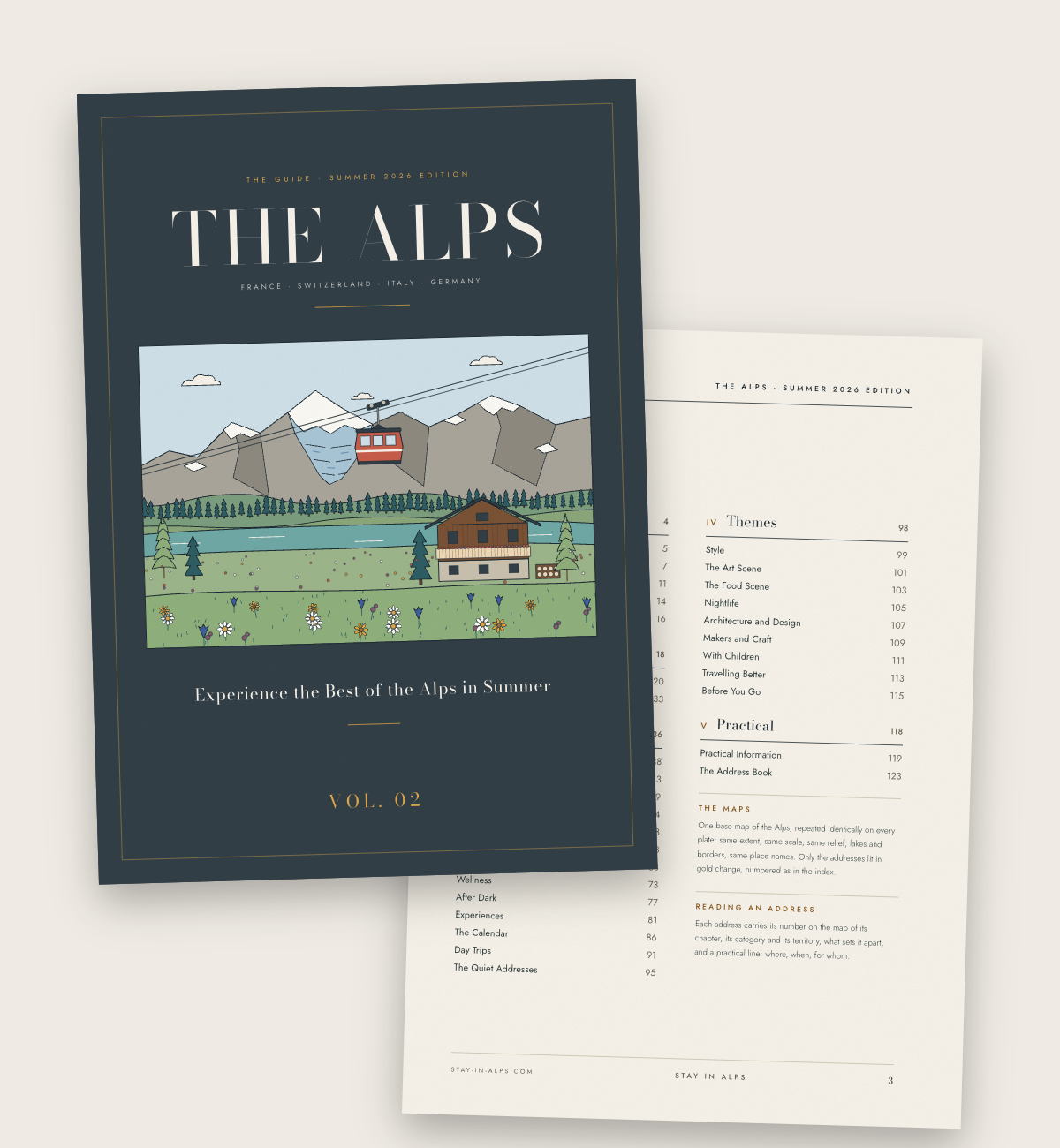
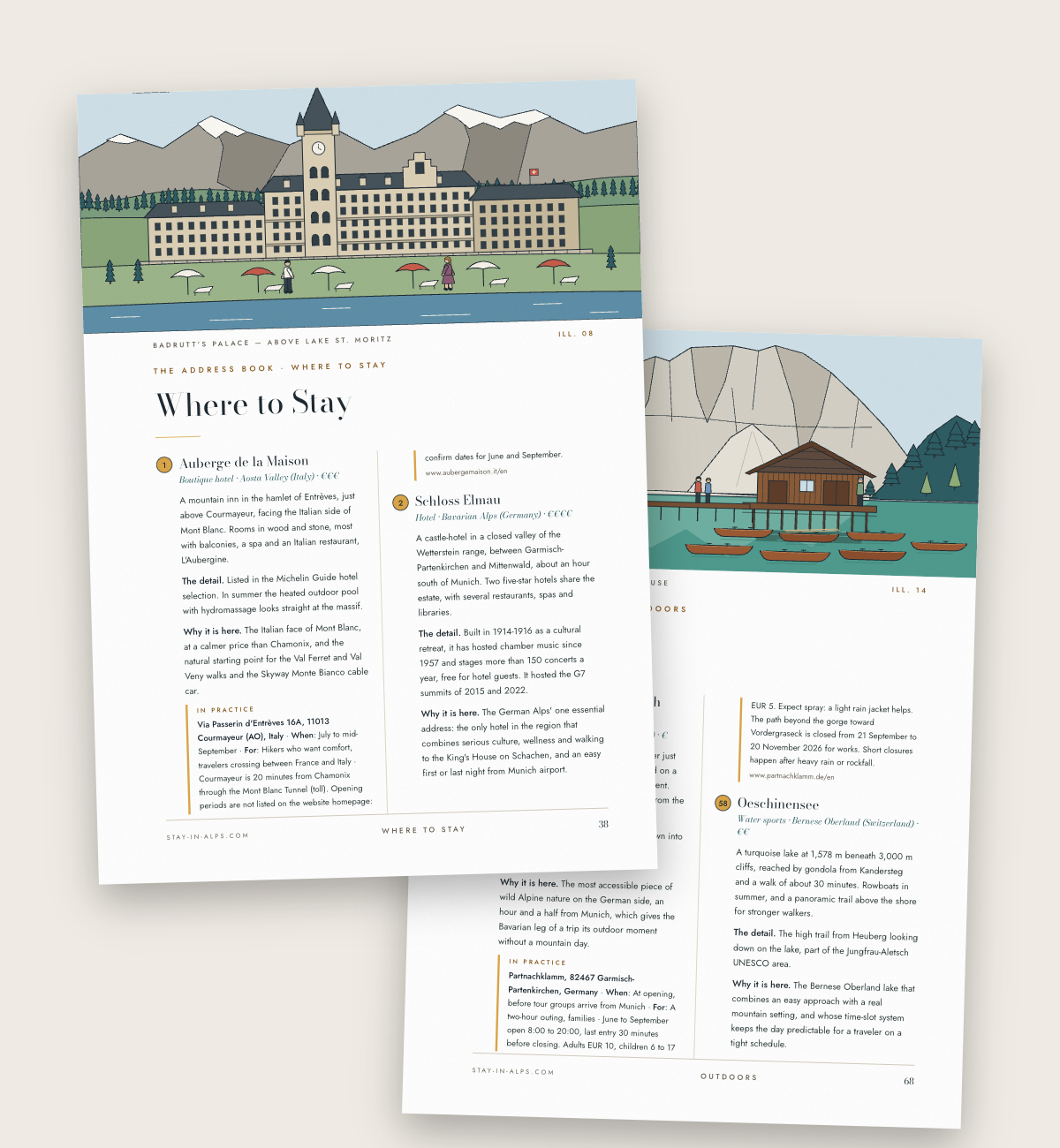
125 plates. 102 numbered addresses, from a family hotel in Chamonix run by the same family since 1903 to a mountain hut on the Alpe di Siusi that seats 25 people for dinner. 21 maps. 30 illustrations, all new for this edition. Three itineraries. Five parts: the opening, the territory, the address book, the themes and the practical section.
The address book is the heart of it: 10 addresses to stay, 12 to eat, 8 to drink, 6 for coffee and early hours, 10 for shopping, 10 for culture and heritage, 8 outdoors, 5 for wellness, 6 after dark, 8 experiences, 8 dates in the calendar, 6 day trips and 5 quiet addresses for travelers who already know the Alps.
Seven summer territories
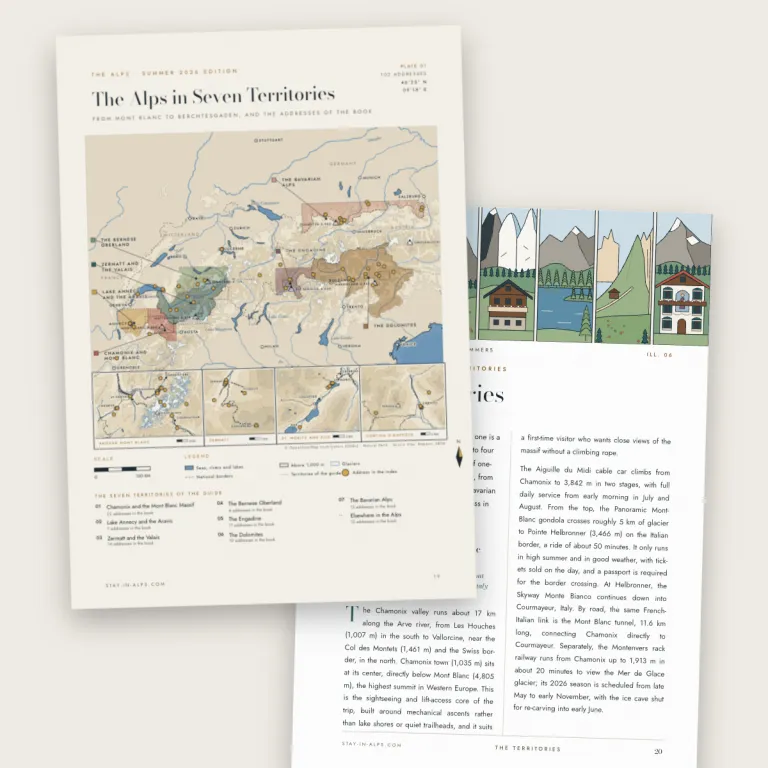
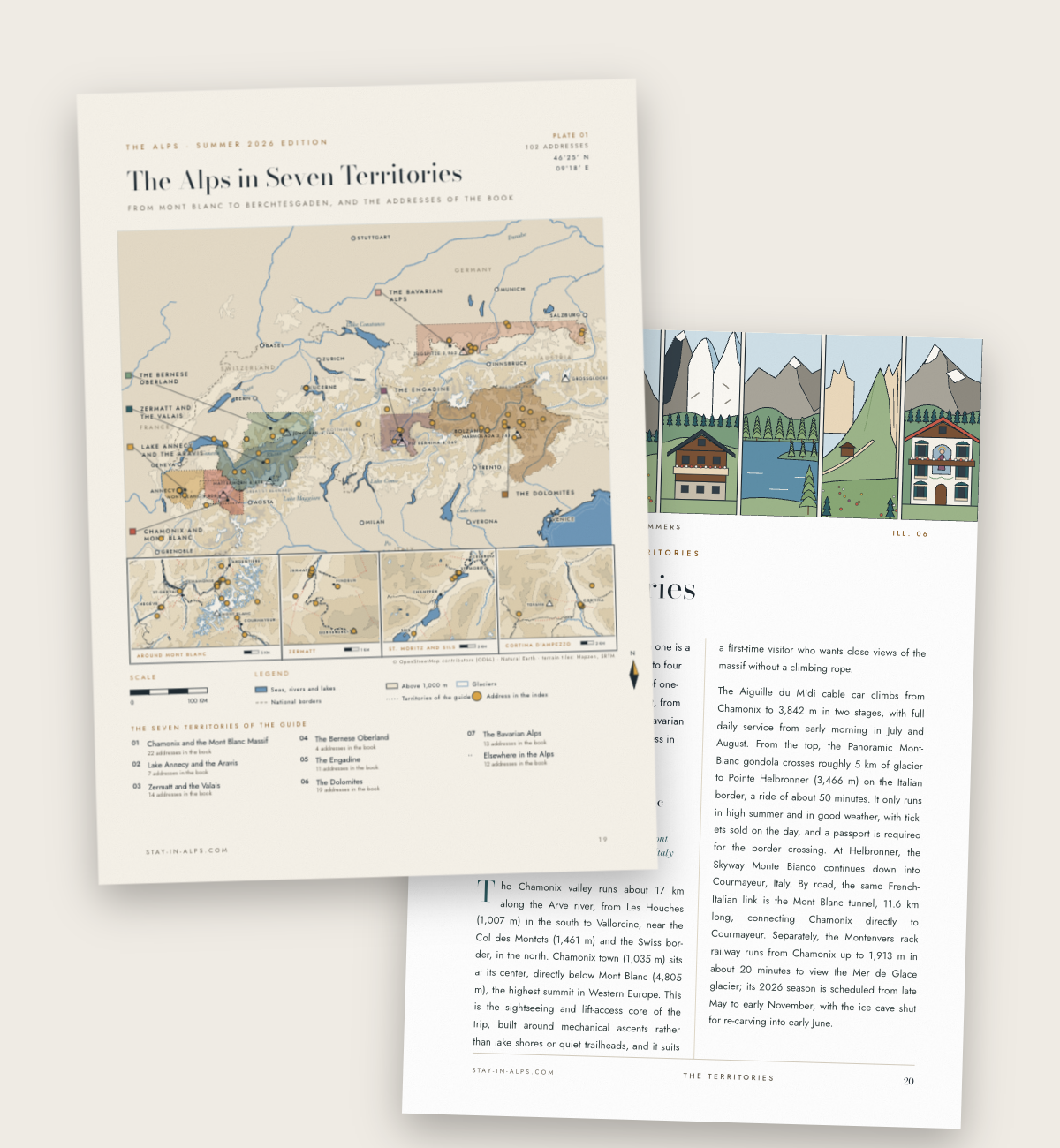
The summer map is not the one of the first volume. Lake Annecy and the Aravis come in, because in July a lake weighs as much as a summit. The seven territories run west to east: Chamonix and the Mont Blanc Massif, Lake Annecy and the Aravis, Zermatt and the Valais, the Bernese Oberland, the Engadine, the Dolomites and the Bavarian Alps.
The addresses are spread the way they really are. Chamonix and Mont Blanc have 22, the largest share of the book, and the Dolomites 19. Zermatt and the Valais have 14, the Bavarian Alps 13, the Engadine 11, Lake Annecy 7 and the Bernese Oberland 4. Twelve more sit elsewhere in the Alps, from the shore of Lake Geneva to Lucerne.
Four short summers rather than one
The When to Go chapter splits the season in four. Late May to mid-June looks open on a calendar and is only half open on the ground: the high passes and the lifts reopen in stages. July has everything running, and Europe arrives at the same time, with French school holidays from July 4. August has three dates that change a day on the ground: Swiss National Day on August 1, Ferragosto on the 15th, the busiest point of the Dolomites year, and the UTMB week in Chamonix at the end of the month.
Then September, which the guide calls the window worth planning around. European schools go back on the 1st, the valleys empty within days, the huts are still open and one Swiss planning guide puts hotel prices 20 to 30 percent below July and August. The guide's advice for a premium trip: aim for September 7 to 20, and check every lift you are counting on before you book.
Every address says why it is there
Each entry carries its number, its category, its territory, a detail that sets it apart and a line on why it is in the guide, then a practical block: where, when, for whom, and how to get in. Le Hameau Albert 1er is there as the reference address for a first summer in Chamonix: a Relais & Châteaux estate run by the Carrier family for five generations, with a starred table and walking distance to the Aiguille du Midi and Montenvers lifts.
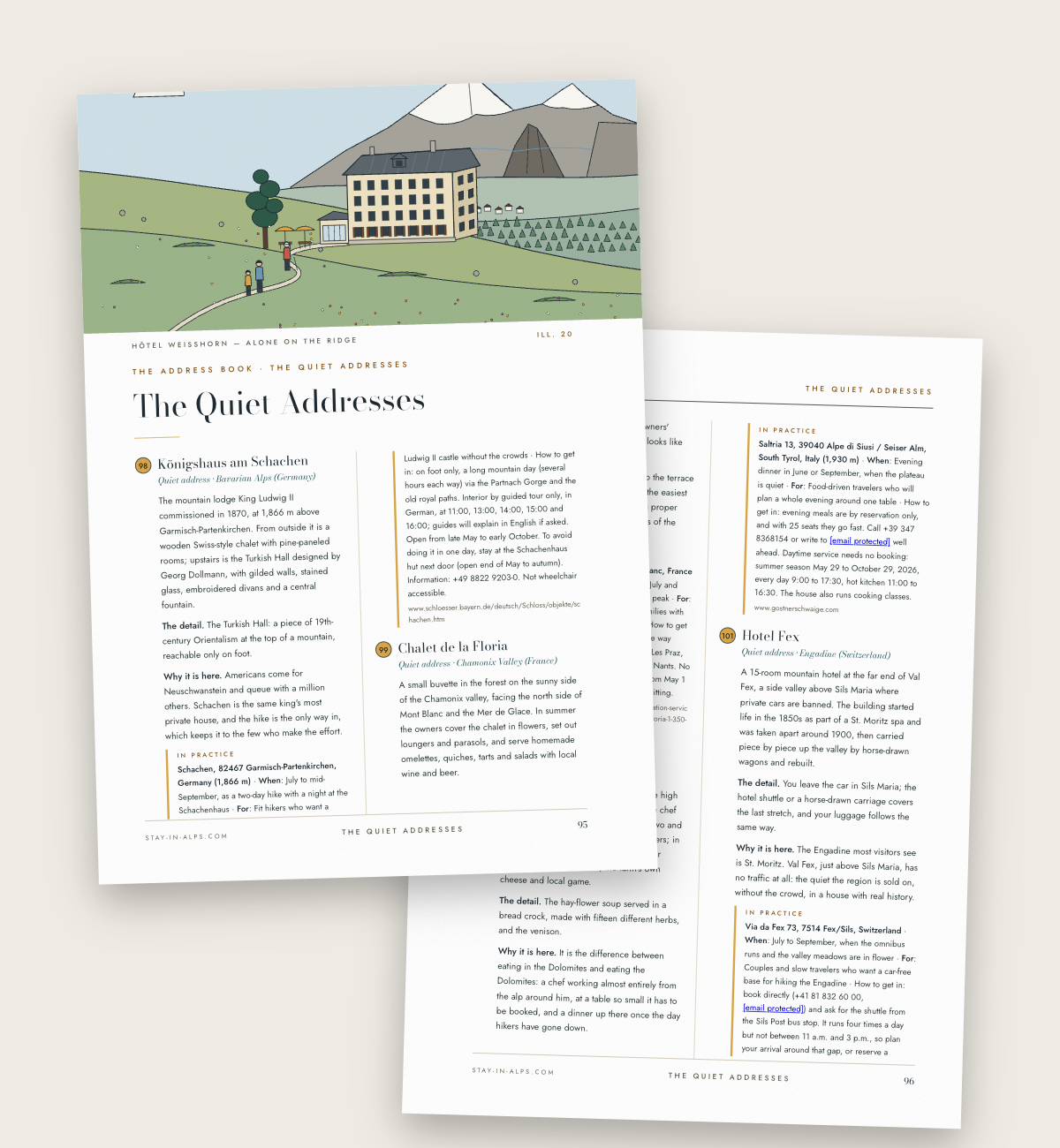
The quiet addresses are there for the opposite reason. Chalet de la Floria is a small buvette in the forest facing Mont Blanc, with no road: about 45 minutes on foot from Les Praz, so the terrace belongs to those who walk up. At Gostner Schwaige, on the Alpe di Siusi, chef Franz Mulser cooks from a kitchen of two and a half square meters, and in the evening the hut seats at most 25 people.
Three itineraries, three to fourteen days
Three routes built around what actually runs in summer, each one naming the reservation that makes or breaks it.
Three days, Mont Blanc from both sides, from one base in Chamonix, flying into Geneva. The first Aiguille du Midi cable car to 3,842 m, the Panoramic Mont-Blanc gondola across the glaciers to Pointe Helbronner and down to Courmayeur by the Skyway, then the red rack railway to Montenvers and the Mer de Glace.
Seven days, Switzerland by panoramic train, with no car, flying into Zurich and home from Milan. Three days in Zermatt with the Gornergrat Bahn, the Glacier Express to St. Moritz, two days on the Engadine lakes, then the Bernina Express to Tirano in Italy.
Fourteen days, Bavaria, the Dolomites, Switzerland and Mont Blanc, the full arc of the range, flying into Munich and out of Geneva. The Zugspitze and Neuschwanstein, four days in Val Gardena with the Seceda cable car, which now requires a time slot, St. Moritz, the Glacier Express to Zermatt, and Chamonix to finish.
When to read it
Before you book rather than after. The guide says which weeks to aim for, which lifts and huts are open when, and which reservations have to be made months ahead, from hut dinners to the festival weeks of the calendar. Its page gives access to the download. It opens in your browser, and it is free.