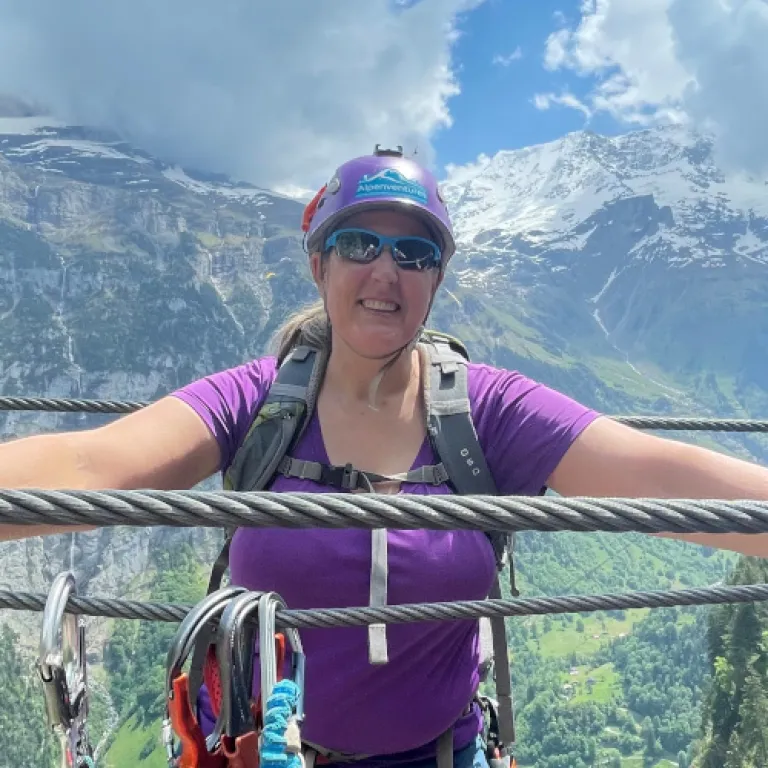
Brittany, you left a successful career in Higher Education to found Alpenventures UNGUIDED. What was the personal turning point that made you commit to self-guided, autonomous adventures in the Alps, and how did that shape the way you design your tours today?
I loved working in higher education, but after moving to Germany and experiencing a series of unexpected events, I began to recognize a real need for self-guided tours in the Alps. I was able to experience the region like a local, while many of my English-speaking friends struggled to find the most authentic and interesting adventures without some level of local support.
There were two final tipping points for me. The first was when a friend who is extremely experienced and competent in alpine environments booked a guide for a hut-to-hut tour simply because she needed help arranging the hut reservations. The second was taking a couple of English-speaking colleagues on their first trip to the Alps in my campervan and seeing firsthand how much local knowledge made a difference to their experience.
Those experiences helped shape the concept behind Alpenventures UNGUIDED. I wanted to give independent travelers the information, logistics, and local knowledge they need to experience the Alps authentically and confidently on their own—without requiring them to join a guided group. That philosophy still shapes the way we design our tours today.
For someone used to either fully guided tours or completely DIY trips, how would you concretely explain what it means to organize an autonomous outdoor adventure in the Alps with Alpenventures UNGUIDED? What are the key elements that make it feel both independent and supported at the same time?
Booking a self-guided tour gives travelers much of the convenience of a guided tour while preserving the independence of traveling on their own. Guests choose their own dates and travel companions, and they retain the flexibility to make decisions along the way, including route variations, shortcut options, and weather-related diversions.
At the same time, much of the logistical work is taken care of for them. We plan the route, organize the key logistics, and provide the detailed information they need to navigate the trip independently. It creates a strong balance between freedom and support.
That said, self-guided travel still requires active participation. Guests need to take the time to read and understand the route and tour information we provide, so they are properly prepared and able to make informed decisions during the trip.
You often work with experienced outdoor enthusiasts who don’t necessarily know the intricacies of the Alps. What are the most common mistakes or blind spots you see when people try to organize hut-to-hut or via ferrata trips on their own, and how do you build your eGuidebooks and logistics to help them avoid these pitfalls?
The Alps are beautiful and are a popular bucket-list destination, but these steep and challenging mountains are often underestimated. One of the most common mistakes we see is hikers focusing too much on distance and not enough on elevation gain and loss. In the Alps, the amount of climbing and descending is often a much better indicator of how difficult a day will feel than the number of kilometers alone.
The terrain itself can also make a route feel significantly harder, especially for hikers who do not have much alpine experience. Steep ascents and descents, rocky trails, exposed sections, and changing weather can all add to the physical and mental demands of a day.
We plan our itineraries very carefully with these factors in mind, and our eGuidebooks are designed to help customers understand what to expect each day. We emphasize elevation gain and loss, terrain, route characteristics, and any particular challenges so that hikers can assess each stage realistically and make informed decisions along the way.
The Alps are iconic but also fragile and increasingly crowded in certain hotspots. When you design or refine an itinerary like the Tour du Mont Blanc or the Walker’s Haute Route, what is your decision-making process to balance adventure, safety, authenticity, and your Responsible Travel Score?
It is a very individual process, because the right balance depends heavily on each customer’s preferences, experience, and priorities. During the booking process, we ask about those preferences and then work with the available accommodations and routing options to build the best possible itinerary for them.
We can do this most effectively when customers give us a flexible date range, because that allows us to work around availability and, where possible, avoid the busiest dates or overused sections. We also look at factors such as route difficulty, safety, the character of the overnight stops, and how authentic the overall experience feels rather than simply following the most popular version of an itinerary.
Our Responsible Travel Score is part of that decision-making process as well. It allows our customers to understand issues such as crowding, local economic benefit, transportation, and the overall impact of the trip when choosing their tour.
You’ve personally scouted routes and built local partnerships both in the Alps and in South America. Can you share a concrete example of a time when your on-the-ground experience led you to significantly change an itinerary, and what that reveals about what it really takes to offer safe, autonomous adventures?
All of our tours are scouted and tested before we launch them, so we have never had to make a major change afterward because of something we discovered on the ground. We put a great deal of work into making sure each itinerary is well organized, realistic, and safe before it becomes available to customers.
That said, we strongly believe in continuous improvement. Every year, members of our team are out on the trails checking routing, written directions, accommodation quality, and current trail conditions. We combine those findings with customer feedback and use them to identify and prioritize improvements to both the itineraries and the supporting tour material.
For us, offering safe, autonomous adventures means that the work does not stop once a tour is launched. Routes, conditions, accommodations, and infrastructure change, so the information we provide has to be reviewed and refined continuously. That ongoing process is a major part of what allows our customers to travel independently with confidence.
Looking ahead, how do you see self-guided, autonomy-focused adventure travel in the Alps evolving over the next 5–10 years, especially with climate change, overtourism, and technology (navigation apps, AI, etc.) transforming how people plan and experience these trips?
I expect several current trends to continue, including increasing pressure on well-known hotspots and more inexperienced hikers venturing into challenging alpine environments. Navigation apps, AI tools, and social media have made it easier than ever to discover and plan outdoor adventures, which is positive in many ways, but they can also create a false sense that complex alpine trips are simple to organize and assess.
We increasingly see self-planned hikers who have planned itineraries that are unrealistic for their experience or fitness level, without fully understanding the risks associated with terrain, elevation, weather, or remoteness. As technology makes trip planning easier, I believe the need for good judgment, realistic difficulty assessments, and reliable local information will become even more important.
At Alpenventures UNGUIDED, our goal is to give customers an exceptional experience while also preparing them to travel safely and independently. That means we invest significant effort in education, detailed route information, and realistic expectations about difficulty and risk.
We also see a major opportunity to direct travelers beyond the most famous bucket-list routes. Some of the most rewarding experiences in the Alps are on quieter trails that are more authentic, less crowded, and every bit as beautiful. Encouraging travelers to explore those areas can improve their experience while also helping distribute tourism more sustainably across the region.
For readers dreaming of planning their first autonomous multi-day adventure in the Alps but feeling intimidated by logistics, language, and safety, what honest, practical advice would you give them to get started and to know when they should seek support from a company like yours?
The first step is to have a realistic understanding of what you are capable of doing. How much distance can you comfortably cover each day, and more importantly, what is your realistic maximum daily elevation gain? From there, I would recommend planning an itinerary that is somewhat more conservative than those maximums.
This should be an experience you love and remember, not a sufferfest. In my experience, having a well-balanced itinerary with manageable days that are long enough to stay interesting usually has a much greater impact on the overall enjoyment of a trip than fixating on a particular mountain hut a favorite blogger stayed at or trying to cover as much ground as possible.
The challenge is that creating that kind of itinerary can be surprisingly difficult on some of the most popular routes. Accommodation availability can create significant bottlenecks, and if you do not know the route well, it can be hard to understand which sections offer flexibility and which do not.
Fit and experienced hikers who are comfortable with long days, open to dormitory accommodation, and flexible with their travel dates can often put together a workable itinerary on their own. But hikers who need shorter stages, strongly prefer private rooms, have fixed travel dates, or simply do not want to spend a great deal of time navigating the logistics will often have a much better experience with a professionally organized self-guided tour.
Learn more: https://www.alpenventuresunguided.com/