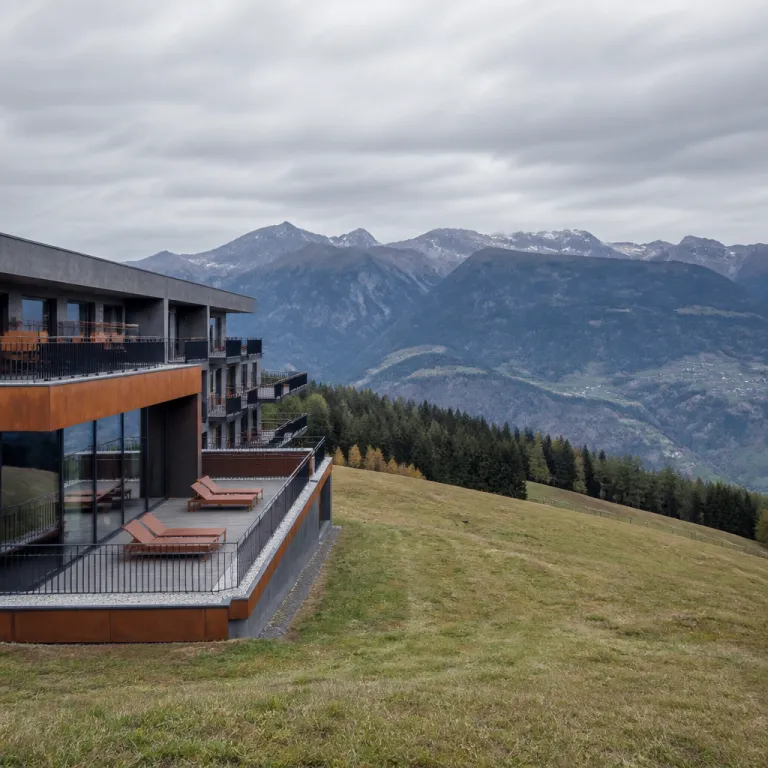
Maranza: A Sun-Drenched Terrace Above the Eisack Valley
Maranza sits at 1,414 metres on a south-facing terrace above the Eisack Valley in South Tyrol, a small village of roughly 450 residents that collects more than 280 days of sunshine each year. The German name is Meransen, and both versions appear on signs and maps with the bilingual ease that characterises this part of the Italian Alps. Below, the valley floor connects Bressanone to the Puster Valley. Above, the peaks of the Pfunderer Mountains and the Zillertal Alps form a serrated horizon. It is a position that grants hotels in Maranza something that larger, more famous South Tyrol resorts cannot always deliver: an uninterrupted panorama across the Dolomites and the central Alps from virtually every room with a south-facing window.
The village belongs to the municipality of Rio di Pusteria and forms part of the Gitschberg Jochtal holiday region, a designation that links it with the neighbouring village of Valles and the ski area that connects both. For a settlement of its size, Maranza supports a surprisingly well-developed hotel infrastructure, with properties ranging from traditional Gasthof accommodation to polished wellness hotels with heated pools, spa facilities, and half-board dining that draws on both Tyrolean and Mediterranean traditions.
The Gitschberg Jochtal Ski Area
The Gitschberg Jochtal ski resort is the largest in the Eisack and Wipp valleys, offering 55 kilometres of groomed pistes served by 15 lift facilities between altitudes of 1,307 and 2,510 metres. From Maranza, the Gitschberg-Nesselbahn gondola provides direct access to the ski area, depositing skiers on the upper slopes within minutes of leaving their hotel. A parallel access point exists at the Jochtalbahn lift in Valles, and the two sectors are linked on-mountain, creating a varied ski day without the need to return to the valley floor.
The terrain suits intermediate skiers and families well. The majority of the 25 pistes are graded blue or red, with long, consistent runs that descend through open alpine meadows above the treeline before entering forest corridors lower down. The gradients are forgiving enough for improving skiers to build confidence, while the red runs offer sufficient variety to hold the interest of more experienced guests staying for a full week. Four toboggan runs add a non-skiing option that families with younger children appreciate, and the snow reliability at this altitude is good through the core winter season.
What Gitschberg Jochtal lacks in sheer scale compared to the Dolomiti Superski megaresorts, it compensates for in atmosphere. Lift queues are rare, the mountain restaurants serve honest South Tyrolean food at reasonable portions, and the pace on the slopes feels unhurried. Hotel guests in Maranza who have skied the busier resorts in Val Gardena or Alta Badia often remark that the skiing here is more enjoyable precisely because it is less congested.
Views from the Summit
The viewing platforms near the upper stations of the Gitschberg lift system are among the most impressive in South Tyrol. More than 500 peaks are visible on a clear day, spanning the Pfunderer Mountains, the Zillertal Alps, and the western Dolomites. The panorama alone justifies the lift ticket, and many hotel guests in Maranza ride up specifically for the views even on days when they have no intention of skiing. In summer, the same platforms serve as starting points for high-altitude hiking trails that traverse the Almenregion, the network of alpine pastures that defines the landscape above the village.
Summer in Maranza: Hiking and the Almenregion
The Gitschberg Jochtal Almenregion is a designated hiking area that encompasses the alpine pastures, meadows, and high trails above Maranza and Valles. The terrain is gentler than the rocky Dolomite peaks to the south, characterised instead by rolling grasslands, scattered farmsteads, and a network of marked trails that connect mountain huts where hikers can stop for lunch or refreshments.
From hotels in Maranza, the gondola operates in summer as well, providing access to the high-altitude trail network without the initial climb. A popular circuit from the upper station traverses the Gitschberg ridge with continuous views before descending through meadows to the Bacherhütte or the Ochsenalm, both of which serve traditional South Tyrolean dishes and locally brewed beer. The walking is accessible to guests of moderate fitness, and the altitude gain on most routes is manageable within a half-day excursion.
For more ambitious hikers, the trails extend northward into the Pfunderer Mountains, where the terrain becomes wilder and the foot traffic lighter. Multi-day hut-to-hut routes are available for experienced mountain walkers, and hotel staff in Maranza are well placed to advise on routes, conditions, and the availability of overnight accommodation at the higher refuges.
The Valle d'Altafossa
The Altafossa Valley, accessible from the outskirts of Maranza, cuts northward into the mountains and provides a walking environment quite different from the open Almenregion. Dense forest, rushing streams, and a series of small waterfalls give way to high pastures where the valley opens out beneath steep ridgelines. In winter, this valley transforms into a snow-covered landscape suitable for snowshoe excursions and cross-country skiing. In summer, it is one of the quieter walks available from the village, and hotel guests looking for solitude rather than summit views find it particularly appealing.
Hotels in Maranza: What to Expect
The hotel offering in Maranza has developed steadily over the past two decades, and the standard across the village is now notably high for a settlement of its size. Most properties are family-owned, a characteristic that shapes the service culture. Staff know returning guests by name, dietary requirements are remembered from one stay to the next, and the general atmosphere tends toward warm informality rather than corporate efficiency.
Four-star hotels in the village typically include wellness and spa facilities with Finnish saunas, steam baths, infrared cabins, and in several cases a heated indoor or outdoor pool with views across the valley. The spa areas are designed for genuine use rather than photographic display, with treatment menus that draw on South Tyrolean traditions including hay baths, pine oil wraps, and herbal compresses using locally harvested plants.
Half-board is the standard arrangement at most hotels in Maranza, and the evening meals are a highlight rather than an obligation. Kitchens serve a mix of Tyrolean and Italian dishes, often with a daily menu that reflects seasonal availability. Speck, dumplings, game, polenta, and local cheeses appear regularly, alongside lighter options that reflect the Mediterranean influence that reaches this far north through the Adige corridor. Wine lists lean toward the excellent producers of Alto Adige, with Gewurztraminer, Lagrein, and Schiava well represented.
Room Standards and Mountain Views
Rooms in Maranza hotels tend toward the wood-and-stone aesthetic common to South Tyrol, though the better properties have updated their interiors with contemporary touches that soften the traditional alpine heaviness. Balconies are almost universal, and given the village's south-facing orientation, many rooms receive direct sunlight for the majority of the day. The views from upper-floor rooms can be extraordinary: the full sweep of the Dolomites, from the Geisler peaks above Val di Funes to the distant profile of the Marmolada, unfolds across the southern horizon in conditions of unusual clarity.
The silence at night is notable. Maranza is small enough and elevated enough that light pollution is minimal and traffic noise negligible after the last bus of the evening. For guests accustomed to city hotels or larger resort properties, the depth of mountain quiet can feel almost disorienting on the first night before becoming, by the second, the feature they value most.
Bressanone and the Eisack Valley
The town of Bressanone, known in German as Brixen, sits in the valley below Maranza and is reachable by car or bus in roughly 15 minutes. It is the oldest town in Tyrol, with a cathedral dating to the tenth century, a bishops' palace that now houses an extensive diocesan museum, and a compact historic centre of arcaded streets and painted facades that rewards a morning's exploration on foot.
Bressanone also provides the practical amenities that a small village like Maranza naturally lacks: pharmacies, specialist shops, a wider selection of restaurants, and a twice-weekly market that draws producers from across the valley. Several hotel guests in Maranza treat an afternoon in Bressanone as a regular part of their holiday rhythm, combining a cultural excursion with an errand run before returning to the mountain for the evening.
The Eisack Valley itself is one of the most important wine-producing corridors in Alto Adige, and the vineyards along the valley floor between Bressanone and Bolzano produce some of the finest white wines in northern Italy. Tastings and cellar visits are available at numerous estates, and hotel concierge teams in Maranza can arrange appointments with producers who are otherwise difficult to access without a local contact.
Families and the Appeal of a Smaller Resort
Maranza draws a significant proportion of family travellers, and the village infrastructure reflects this. The ski area operates family-friendly pricing and dedicated learning zones, the summer hiking trails include options short enough for younger legs, and several hotels maintain in-house childcare or kids' clubs that allow parents to ski or hike unencumbered during peak activity hours.
The smaller scale of the village is itself an advantage for families. Children gain independence more quickly in an environment where the distances are short and the traffic minimal. The walk from a hotel to the gondola station, from the village centre to the nearest restaurant, from the swimming pool to the playground: all are measured in minutes rather than the quarter-hours that larger resorts sometimes impose. This compact geography reduces the logistical friction that can turn a family mountain holiday from a pleasure into a project.
Practical Information for a Stay in Maranza
Maranza is reached most easily via Bressanone, which sits on the main Brenner motorway between Innsbruck and Bolzano. From Bressanone, a winding mountain road climbs to the village in roughly 15 minutes, with the views improving around each switchback. The road is well maintained and cleared promptly after snowfall, though winter tyres are mandatory throughout the season.
The nearest airports are Innsbruck, Bolzano, and Verona. Innsbruck offers the shortest transfer time, roughly 90 minutes including the final climb. Several hotels arrange private transfers, and the regional bus service connects Bressanone with Maranza on a regular schedule throughout the year.
Within the village, a car is useful but not essential. The gondola station is walkable from most hotels, the ski bus supplements the gondola connection in winter, and the compact village layout means that evening outings to restaurants or bars require nothing more than a short stroll and a warm jacket.
Maranza does not compete with the marquee resorts of the Dolomites on scale or glamour. It competes on something more durable: the quality of the light, the warmth of the welcome, and the satisfaction of a mountain holiday where the proportions are human rather than industrial. Hotels here understand that their guests have chosen a small village deliberately, and the hospitality is calibrated accordingly. The skiing is varied enough for a week, the hiking almost limitless, and the spa and pool facilities at the better properties provide the recovery that active days demand. For travellers who have grown weary of resorts that promise authenticity while delivering its opposite, Maranza and its hotels offer a South Tyrol experience that is genuinely, quietly, the real thing.